Introduction
Planning a trip across Canada can be exciting. From busy city streets to beautiful mountain roads, the country offers many places worth exploring. Renting a car gives travellers more freedom to enjoy these destinations at their own pace.
However, renting a car requires more than choosing a vehicle and paying its daily rental fee. You must also consider insurance, fuel, taxes, parking, security deposits, and additional charges. These expenses can increase your travel budget if you do not plan carefully.
For first-time visitors, understanding rental costs before booking is especially important. A vehicle with a low advertised price may become expensive after adding extra services and fees.
Whether you are a tourist, student, working professional, family traveller, or backpacker, a proper budget can make your journey easier.
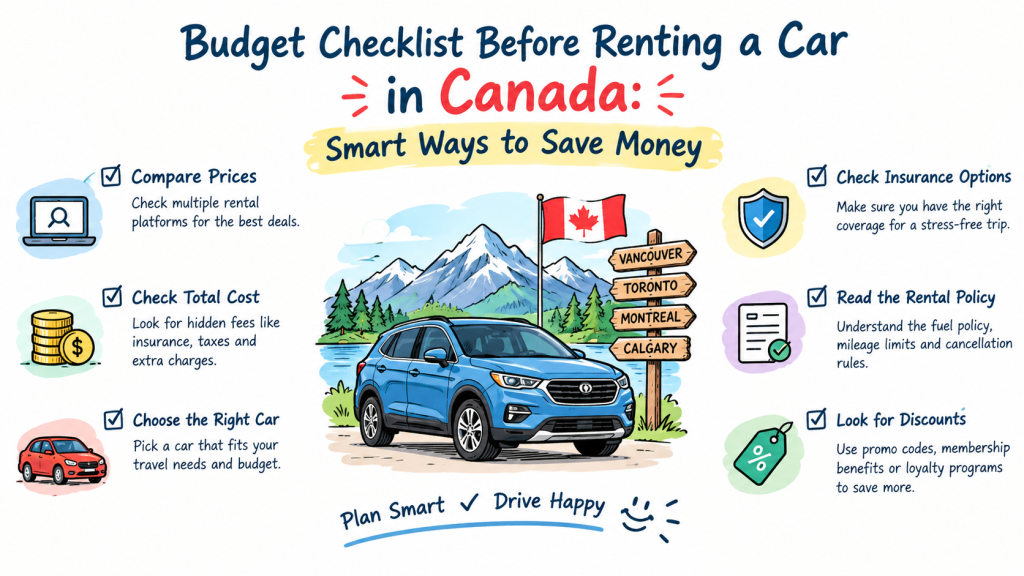
This budget checklist before renting a car in Canada explains the main expenses you should consider. It also covers practical ways to compare rental options, avoid hidden charges, and select a vehicle that matches your travel needs.
With proper planning, you can enjoy convenient transportation without putting unnecessary pressure on your travel budget.
Understand the Main Costs of Renting a Car in Canada
Before booking a rental vehicle, understand the different expenses involved. The advertised rental price does not always represent the final amount you need to pay.
Several additional charges may appear during the booking process.
Daily Rental Charges
The daily rental price is usually your first expense. It depends on the vehicle type, rental company, location, season, and booking duration.
For example, economy cars generally cost less than SUVs and luxury vehicles. Larger vehicles may also have higher fuel expenses.
When comparing rental options, consider the total booking cost rather than focusing only on the daily rate.
Taxes and Additional Fees
Car rentals in Canada may include different taxes and service charges.
Common charges include:
- Goods and Services Tax (GST), where applicable.
- Provincial sales tax or Harmonized Sales Tax (HST).
- Airport facility and concession charges.
- Vehicle licensing and recovery fees.
- Location-specific service charges.
The exact amount depends on the rental location and applicable regulations.
Always review the final booking summary before making payment.
Security Deposit
Many rental companies require a refundable security deposit or payment card authorization.
The deposit amount may depend on the vehicle category, rental provider, driver eligibility, and insurance arrangements.
Before booking, confirm:
- The required deposit amount.
- Accepted payment methods.
- Deposit refund conditions.
- Expected release time.
- Possible deductions for damage or additional charges.
Remember that a security deposit is separate from the actual rental payment.
Include Insurance Costs in Your Rental Budget
Insurance is an important part of renting a car in Canada. It can help protect you against certain financial losses during your journey.
However, different rental companies offer different coverage options.
Collision Damage Waiver
A Collision Damage Waiver (CDW) or Loss Damage Waiver (LDW) may reduce your financial responsibility if the rental vehicle gets damaged or stolen.
These products may include exclusions, deductibles, and specific conditions.
Before accepting this option, understand what it covers and what it does not cover.
Third-Party Liability Coverage
Third-party liability coverage helps protect against certain claims involving injuries or property damage caused to others.
Some rental arrangements include basic liability protection.
However, coverage limits and conditions can vary. Confirm the details before collecting the vehicle.
Personal Accident Coverage
Some providers offer additional protection for drivers and passengers.
This coverage may help with certain accident-related expenses.
Check whether your existing travel insurance or personal insurance already provides similar benefits.
Personal Effects Coverage
Personal effects coverage may protect certain belongings inside the rental vehicle.
However, exclusions and coverage limits usually apply.
Review your existing travel insurance before purchasing additional protection.
Insurance Checklist
Before confirming your rental, check:
- What insurance comes with the vehicle?
- Is collision damage protection included?
- What deductible applies?
- Does the coverage include theft?
- Are tyres, glass, and underbody damage excluded?
- Does your credit card provide rental vehicle protection?
- Are international visitors eligible for the available coverage?
Understanding insurance conditions can help you avoid unexpected expenses.
Calculate Fuel Expenses Before Booking
Fuel is another important expense when renting a car in Canada.
Your fuel budget depends on driving distance, vehicle efficiency, local fuel prices, and road conditions.
For example, driving around downtown Toronto requires a different fuel budget from travelling between Vancouver and Calgary.
Check Vehicle Fuel Efficiency
Different vehicles consume different amounts of fuel.
An economy car may use less fuel than a large SUV. However, your final choice should also consider passengers, luggage, and road conditions.
If you plan to drive long distances, compare fuel efficiency before booking.
Understand the Fuel Policy
Rental companies may offer different fuel arrangements.
Full-to-Full Policy
You collect the vehicle with a full tank and return it with a full tank. This option helps you manage fuel expenses.
Prepaid Fuel Policy
You pay for fuel before collecting the vehicle. Check whether the company refunds unused fuel. Many prepaid policies do not offer refunds.
Same-Level Fuel Policy
You return the vehicle with approximately the same fuel level as when you collected it.
Always photograph the fuel gauge during pickup.
Calculate Your Estimated Fuel Budget
Consider this example:
You plan to drive 500 kilometres in a car that consumes 8 litres per 100 kilometres.
Your estimated fuel requirement will be:
500 × 8 ÷ 100 = 40 litres.
Multiply 40 litres by the local fuel price to calculate your estimated fuel expense.
This simple calculation can help you prepare a realistic travel budget.
Select the Right Rental Car for Your Budget
Choosing the right vehicle can help control your overall rental expenses.
Do not select a car only because it has the lowest daily price. Consider your travel distance, passenger count, luggage, and road conditions.
Economy Cars
Economy cars are suitable for solo travellers, couples, and small families.
Their main advantages include:
- Lower rental costs.
- Good fuel efficiency.
- Easier city parking.
- Convenient handling.
- Suitable size for urban travel.
They can be practical for exploring Toronto, Montreal, Ottawa, and other Canadian cities.
Compact and Mid-Size Cars
Compact and mid-size cars provide additional passenger and luggage space.
They are useful for couples, small families, and travellers planning longer journeys.
A mid-size vehicle can provide more comfort without requiring the higher rental budget of an SUV.
SUVs
SUVs offer more passenger space and luggage capacity.
They may suit families and travellers visiting destinations with changing road conditions.
However, larger vehicles can have higher rental prices and fuel expenses.
If you plan to visit mountain destinations in Alberta or British Columbia, check seasonal road conditions and winter equipment requirements.
Minivans
Minivans are useful for families and larger travel groups.
They provide additional seating and luggage capacity.
However, their rental prices and fuel consumption may be higher than those of smaller vehicles.
Electric Vehicles
Electric rental cars can help reduce petrol expenses.
However, you should plan your charging stops before starting your journey.
Check charging station availability, charging fees, driving range, and charging facilities at your accommodation.
Prepare the Required Driving Documents
Preparing the correct documents before booking can save time and prevent collection problems.
Rental requirements depend on the company, province, and driver’s country of residence.
Valid Driving Licence
You generally need a valid driving licence for the vehicle category you want to rent.
International visitors should check whether their home-country licence is accepted.
Some rental companies may require an International Driving Permit (IDP), especially when the original licence is not in English or French.
An IDP does not replace your original driving licence.
Passport and Government Identification
International tourists may need to provide:
- Valid passport.
- Home-country driving licence.
- International Driving Permit, if required.
- Additional identification requested by the rental provider.
Canadian residents generally need a valid provincial or territorial driving licence.
Payment Card
Many rental companies require a credit card in the main driver’s name.
Some providers accept debit cards, but additional conditions may apply.
Confirm the accepted payment methods before making a reservation.
Minimum Age Requirements
Rental companies often set minimum age requirements.
Some providers charge additional fees for younger drivers.
Age rules may vary according to vehicle category, province, and rental company.
Check these conditions before booking.
Check for Hidden Car Rental Charges
Hidden charges can increase your final rental bill.
Before confirming your booking, review the rental agreement carefully.
Additional Driver Fees
If another person will drive the rental car, the company may charge an additional driver fee.
Some providers allow certain eligible family members or spouses without extra charges.
However, every driver must meet the rental company’s requirements and appear on the agreement.
Young Driver Fees
Some rental companies charge additional fees for drivers below a certain age.
These charges can increase the cost of short-term rentals.
Check the age policy before choosing a vehicle.
Late Return Fees
Returning your rental car after the agreed time may result in additional charges.
Some companies offer a grace period, while others calculate extra rental time differently.
Allow enough time for traffic, refuelling, and vehicle inspection.
One-Way Rental Charges
Suppose you collect a vehicle in Toronto and return it in Montreal.
The rental company may charge an additional one-way fee.
These charges depend on vehicle availability, rental location, and company policy.
Check the final amount before confirming your reservation.
Cleaning and Damage Fees
Rental companies may charge for excessive dirt, stains, smoking, or vehicle damage.
Before leaving the pickup location, inspect the vehicle carefully.
Take photographs of existing scratches, dents, and other visible damage.
Ask the provider to record these issues in the rental agreement.
Plan Parking, Tolls, and Road Expenses
Your rental budget should include more than the vehicle price, insurance, and fuel.
Parking and road-related expenses can become significant in busy Canadian cities.
Parking Costs
Parking prices depend on location, duration, and parking facilities.
For example:
- Downtown Toronto can have expensive parking.
- Central Vancouver offers several paid parking areas.
- Montreal has different parking rules across neighbourhoods.
- Smaller towns may offer more affordable parking options.
Before booking, check whether your hotel or accommodation provides parking.
This can help you avoid unnecessary daily parking expenses.
Highway Tolls
Some Canadian highways and bridges charge tolls.
Ontario’s 407 ETR is one example of a toll highway.
If your journey includes toll roads, understand how your rental provider handles payments.
Some rental companies charge administrative fees in addition to toll expenses.
Winter Driving Expenses
Winter travel requires additional preparation.
Depending on your route and rental agreement, consider:
- Winter tyres.
- Suitable seasonal equipment.
- Roadside assistance.
- Weather-related travel delays.
- Additional fuel consumption.
Some Canadian provinces and routes have seasonal tyre requirements.
Check the applicable rules before travelling.
Compare Rental Prices Before Booking
Comparing different rental options is one of the easiest ways to manage your budget.
However, compare vehicles with similar features, rental conditions, and insurance arrangements.
A cheaper booking may include fewer benefits or stricter rental conditions.
Important Factors to Compare
| Comparison Factor | What to Check |
|---|---|
| Daily rental price | Base cost per day |
| Total rental price | Final cost with taxes and fees |
| Insurance | Included coverage and optional protection |
| Security deposit | Amount and refund conditions |
| Mileage | Unlimited or restricted kilometres |
| Fuel policy | Full-to-full or prepaid |
| Cancellation | Refund and cancellation conditions |
| Additional drivers | Extra driver charges |
| Vehicle category | Size, capacity, and fuel efficiency |
| Roadside assistance | Availability and additional costs |
Book Your Vehicle in Advance
Booking early may provide more vehicle choices.
It can also give you more time to compare rental prices.
This is especially useful during summer holidays, winter travel periods, and major Canadian events.
Compare Different Pickup Locations
Airport rental locations are convenient but may include additional charges.
Compare airport and city-centre pickup options before booking.
However, include the transportation cost of reaching an alternative pickup location.
Practical Ways to Save Money on Car Rentals in Canada
Small decisions can make a noticeable difference to your rental budget.
Use these practical tips to reduce unnecessary expenses.
Choose the Right Rental Duration
Compare daily, weekly, and monthly rental rates.
A weekly booking may offer better value than several separate daily bookings.
However, always compare the total cost before extending your rental period.
Avoid Unnecessary Vehicle Upgrades
Choose a vehicle that meets your actual travel requirements.
A compact car may be sufficient for solo travellers and couples.
Avoid paying extra for a larger vehicle unless you need additional space.
Review Cancellation Policies
Flexible booking conditions can help when your travel plans change.
Check cancellation deadlines, refund rules, and possible cancellation charges.
Check Existing Insurance Benefits
Your personal insurance or credit card may provide rental vehicle protection.
Confirm the coverage period, geographical limits, eligible vehicle types, and exclusions.
This can help you avoid paying for duplicate coverage.
Return the Vehicle on Time
Set a reminder for your return date and time.
Allow enough time for refuelling and inspection.
Returning the vehicle as agreed can help prevent additional rental charges.
Avoid Unnecessary Extras
Review optional services before accepting them.
These may include:
- GPS devices.
- Child safety seats.
- Additional insurance products.
- Roadside assistance upgrades.
- Prepaid fuel packages.
Only purchase services that match your actual requirements.
Common Mistakes to Avoid When Renting a Car in Canada
First-time renters sometimes focus only on the advertised rental price.
This can lead to unexpected expenses and unnecessary problems.
Avoid these common mistakes:
1. Choosing only the cheapest vehicle: A low advertised price may exclude important fees and services.
2. Ignoring insurance conditions: Understand your financial responsibility before collecting the car.
3. Overlooking fuel policies: Returning the vehicle with an incorrect fuel level may result in additional charges.
4. Ignoring mileage restrictions: Some rental agreements limit the distance you can drive.
5. Forgetting parking expenses: Parking fees can increase your travel budget in major cities.
6. Ignoring winter conditions: Snow and icy roads require suitable tyres and careful driving.
7. Skipping vehicle inspections: Photograph existing damage before leaving the pickup location.
8. Returning the vehicle late: Additional rental charges may apply.
9. Allowing an unregistered person to drive: Only approved drivers should operate the rental vehicle.
10. Not reading the rental agreement: Review important conditions before signing.
Avoiding these mistakes can make your rental experience easier and more affordable.
Understand Rental Costs Across Popular Canadian Cities
Your rental budget also depends on your destination.
Canada has large metropolitan areas, mountain destinations, coastal regions, and smaller towns.
Each location has different traffic conditions, parking expenses, and travel requirements.
Toronto
Toronto is a busy city with traffic and paid parking in many areas.
A compact rental car may suit travellers planning short city trips.
If you want to explore nearby destinations, compare daily rates with weekly rental packages.
Vancouver
Vancouver offers access to beaches, parks, and scenic destinations.
However, parking and traffic can affect your budget.
Choose a fuel-efficient vehicle for city travel and nearby road trips.
Calgary
Calgary is a popular starting point for exploring Alberta.
Travellers planning trips to Banff and other mountain destinations should consider longer driving distances, road conditions, and seasonal equipment.
Montreal
Montreal offers many attractions and nearby road-trip opportunities.
Check local parking regulations and winter driving requirements.
A smaller vehicle can be easier to manage in busy neighbourhoods.
Ottawa
Ottawa is suitable for travellers interested in museums, parks, and nearby towns.
Compare rental pickup locations and accommodation parking facilities before booking.
How MotoShare Canada Can Help with Vehicle Rental Planning
Finding a suitable rental vehicle is an important part of planning an affordable journey.
MotoShare Canada aims to support travellers looking for convenient vehicle rental options.
Its vehicle rental marketplace approach can help users explore available options based on their transportation needs.
Easy Online Booking
Online booking makes vehicle rental planning more convenient.
Travellers can explore available options and review booking information before making a decision.
This reduces the time spent searching for suitable transportation.
Wide Range of Vehicles
Different journeys require different types of vehicles.
A compact car may suit city travel, while a larger vehicle may work better for family trips.
MotoShare’s broader vehicle rental approach supports the discovery of suitable transportation options.
Actual availability depends on the listed inventory.
Transparent Pricing
Understanding rental expenses is important for budget-conscious travellers.
Review the listed price, rental duration, deposit requirements, and additional charges before confirming a booking.
Always check the final payable amount.
Flexible Rental Options
Different travellers have different transportation requirements.
Some need a vehicle for a short city trip. Others need one for a longer journey.
Flexible rental periods can help travellers plan transportation according to their schedules.
Available options depend on the vehicle provider.
Convenient Vehicle Discovery
Travellers can explore rental options based on their location and travel requirements.
Before booking, confirm the pickup location, return arrangements, vehicle condition, and rental agreement.
For travellers exploring vehicle rental options in Canada, MotoShare Canada can be a useful starting point.
Frequently Asked Questions About Renting a Car in Canada
1. How much does it cost to rent a car in Canada?
Car rental prices depend on the vehicle, city, season, rental duration, and provider.
Economy cars generally cost less than SUVs and luxury vehicles.
You should also budget for insurance, taxes, fuel, parking, and security deposits.
2. What is the cheapest type of car to rent in Canada?
Economy and compact cars are often among the most affordable rental options.
They suit solo travellers, couples, and small families.
They can also provide better fuel efficiency than larger vehicles.
3. Can international tourists rent a car in Canada?
Yes, international tourists can generally rent cars in Canada if they meet the rental company’s requirements.
They need a valid driving licence and acceptable identification.
Some providers may also require an International Driving Permit.
4. Do I need an International Driving Permit to rent a car in Canada?
Not every international visitor needs an IDP.
Requirements depend on the province, home-country licence, language of the licence, and rental provider.
Check the applicable rules before travelling.
5. Is insurance included in Canadian car rentals?
Some rental agreements include basic coverage, but the exact protection varies.
Additional collision damage protection and other products may cost extra.
Always check the policy, deductible, exclusions, and liability coverage.
6. How much security deposit is required for a rental car?
There is no single deposit amount for all Canadian rental companies.
The amount depends on the provider, vehicle category, location, and payment method.
Confirm the required deposit before booking.
7. Can I rent a car in Canada without a credit card?
Some rental companies accept debit cards, while others require credit cards.
Debit card users may face additional identification, deposit, or eligibility requirements.
Contact the provider before making your reservation.
8. Are there mileage limits on rental cars in Canada?
Some rental agreements offer unlimited mileage, while others include kilometre restrictions.
Check the mileage policy before booking, especially when planning a long road trip.
Additional charges may apply when you exceed the permitted distance.
9. Can I drive a rental car between different Canadian provinces?
Many rental companies allow interprovincial travel.
However, you must check the rental agreement for geographical restrictions.
Also confirm insurance coverage and vehicle-use conditions.
10. Are winter tyres included in Canadian rental cars?
Not every rental vehicle automatically includes winter tyres.
Availability and requirements depend on the province, season, and rental provider.
Ask about winter tyres before booking if you plan to travel during snowy months.
11. What happens if my rental car breaks down?
Contact the rental company’s roadside assistance or emergency support service.
Follow the instructions in your rental agreement.
Avoid arranging expensive repairs without the provider’s approval unless immediate safety concerns require action.
12. Can I return my rental car to a different location?
Some rental companies allow one-way rentals.
However, additional charges may apply depending on the pickup and return locations.
Check availability and the final price before confirming your booking.
13. Is it cheaper to book a rental car in advance?
Booking early can provide more vehicle choices and may offer better rates.
Prices depend on demand, location, vehicle availability, and season.
Compare the total booking price before making a decision.
14. What should I check before collecting a rental car?
Inspect the exterior, tyres, lights, mirrors, interior, fuel level, and mileage.
Photograph existing damage and ask the rental company to record it.
Also check insurance details and emergency contact information.
15. How can I reduce my total car rental expenses in Canada?
Choose an economy vehicle, compare total prices, understand insurance options, and check fuel policies.
Avoid unnecessary upgrades and optional services.
Plan parking, tolls, and driving distances before starting your journey.
Conclusion
Renting a car in Canada can make your journey more comfortable and flexible. However, managing your budget requires more than comparing daily rental prices.You should consider insurance, fuel, taxes, security deposits, parking, tolls, and additional fees before confirming your booking.Choosing the right vehicle can also help control expenses. An economy car may suit city travel, while an SUV may be more practical for certain family trips and mountain journeys.Most importantly, read the rental agreement carefully. Check the vehicle condition, understand the insurance policy, and confirm all payment requirements.A little preparation can help you avoid unexpected expenses and enjoy a smoother travel experience.Whether you are exploring Toronto, discovering Vancouver, visiting Calgary, or planning a road trip through Montreal and Ottawa, make your transportation plans according to your budget.