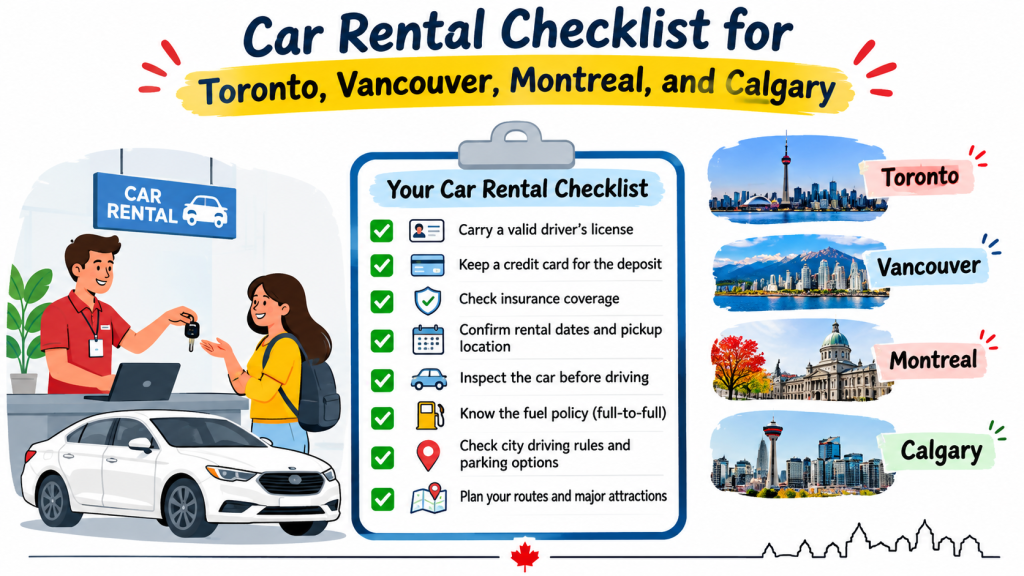
Introduction
Canada offers many exciting places for tourists, students, families, and business travelers. From Toronto’s busy streets to Vancouver’s beautiful landscapes, every city offers a different travel experience. Montreal attracts visitors with its historic neighbourhoods, while Calgary provides easy access to famous mountain destinations.
However, exploring these cities requires proper travel planning. Public transport works well in many areas, but it may not suit every journey. A rental car can provide more freedom, comfort, and control over your travel schedule.
First-time visitors often have questions about driving licences, rental agreements, insurance, deposits, and vehicle inspections. They may also find Canadian road rules and weather conditions unfamiliar.
A proper car rental checklist can help prevent these problems. It allows you to prepare documents, compare rental prices, select the right vehicle, and understand additional charges before booking.
This guide covers everything you should know before renting a car in Toronto, Vancouver, Montreal, or Calgary. It also includes practical advice for international visitors, including travelers from India.
2. Why Is Renting a Car in Canada a Smart Choice?
Canada has large cities and many attractive destinations outside urban centres. A rental car can make travelling between these places easier.
You can plan your journey according to your schedule. You can also carry luggage, stop at interesting locations, and explore destinations that public transport may not reach conveniently.
Here are some important benefits of renting a car in Canada.
Freedom to Explore Different Destinations
A rental car allows you to visit several places without depending entirely on public transport schedules.
For example, visitors staying in Toronto can plan a trip to Niagara Falls. Travelers in Vancouver can explore nearby coastal and mountain destinations.
Similarly, Calgary visitors can plan journeys towards Banff and Lake Louise.
Comfortable Family Travel
Families often carry luggage, shopping bags, and travel equipment. A rental car offers private space and makes it easier to organise family journeys.
You can also choose a vehicle according to the number of passengers.
Convenient Business Travel
Working professionals may need to attend meetings at different locations.
A rental car can help them travel between offices, hotels, conference centres, and business districts.
Better Control Over Travel Time
Rental cars allow travelers to decide when to start and finish their journeys.
This flexibility can help when visiting attractions outside city centres or travelling with children.
Useful for Longer Stays
International students and temporary workers may need transport for grocery shopping, weekend trips, and daily activities.
A short-term or long-term rental may suit their needs when public transport does not provide enough flexibility.
3. Who Should Consider Renting a Car in Canada?
Car rentals can support different travel needs. However, every traveler should compare the cost and convenience before booking.
First-Time Tourists
First-time visitors may prefer a rental car when visiting multiple attractions.
For example, a tourist arriving in Toronto can use a rental car for airport transfers, hotel travel, and nearby sightseeing.
Before driving, learn the local traffic rules and parking regulations.
Indian Travelers Visiting Canada
Many Indian tourists visit Canada for holidays, family visits, education, and business.
Travelers arriving from Delhi, Mumbai, Bangalore, Pune, Hyderabad, Chennai, or Kolkata should understand Canada’s driving system before renting a vehicle.
Canada follows right-hand traffic. Drivers sit on the left side of the vehicle and drive on the right side of the road.
This is different from India, where vehicles drive on the left side.
Indian visitors should also check driving licence requirements, IDP rules, and rental company policies.
International Students
Students may need transportation for campus visits, shopping, social activities, and weekend travel.
A rental car can help with occasional journeys. However, public transport may offer better value for regular city commuting.
Families and Groups
Families and groups can share rental expenses.
A sedan may suit a small family, while a minivan may provide more space for larger groups.
Working Professionals
Professionals travelling for meetings or temporary assignments may prefer rental cars.
They can select vehicles according to their work schedule and travel requirements.
4. Choose the Right Car for Your Travel Needs
Selecting the correct vehicle is an important part of the rental process.
Think about your passenger count, luggage, travel distance, weather, and destination before booking.
Economy Cars
Economy cars suit solo travelers and couples.
They generally provide practical transportation for city journeys. Their smaller size can also make parking easier.
They are suitable for visitors exploring Toronto, Montreal, and Calgary city centres.
Compact Cars
Compact cars offer a balance between passenger comfort and manageable size.
They can suit small families and travelers who need additional space without choosing a large vehicle.
Mid-Size Sedans
Mid-size sedans provide more cabin and luggage space than many economy cars.
They work well for business travelers, couples, and small families planning longer journeys.
SUVs
SUVs offer additional passenger space and luggage capacity.
They may suit family holidays and road trips around Alberta or British Columbia.
However, an SUV does not automatically provide better winter safety. Always check its tyres and equipment.
Minivans
Minivans suit larger families and groups.
They provide flexible seating and generous storage space. They can be useful for airport transfers and longer family holidays.
Electric Vehicles
Electric cars can suit travelers who have access to suitable charging stations.
Before booking, check the driving range, charging network, battery requirements, and return policy.
5. Documents Usually Required for Car Rental in Canada
Rental providers need certain documents to confirm your identity and driving eligibility.
Requirements can differ between companies and provinces. Therefore, check the exact requirements before booking.
Valid Driving Licence
Carry your original and valid driving licence.
International visitors should confirm whether their home-country licence is accepted in their destination province.
Indian visitors should carry their original Indian driving licence.
International Driving Permit
An International Driving Permit can help authorities and rental providers understand foreign driving licences.
It does not replace your original licence.
For Indian travelers, an IDP may be useful when driving in Canada. Requirements depend on the province, licence language, and rental provider.
Passport and Government ID
International visitors should carry their passports and other requested identification.
The rental company may ask for identification during vehicle collection.
Payment Card
Many rental providers require a credit card for the security deposit.
Some providers accept debit cards under specific conditions.
Ask about accepted payment methods before making a booking.
Additional Driver Documents
If another person will drive, the rental company may require their licence and identification.
Make sure every driver appears in the rental agreement.
6. Things to Check Before Renting a Car
Never confirm a rental booking without reviewing the vehicle and rental conditions.
A few simple checks can help prevent unexpected expenses.
Vehicle Condition
Inspect the vehicle before leaving the rental location.
Check the following:
- Exterior scratches and dents.
- Front and rear bumpers.
- Windshield condition.
- Tyre condition.
- Headlights and indicators.
- Side mirrors and windows.
- Seat belts.
- Air conditioning and heating.
- Brakes and steering.
- Dashboard warning lights.
Take photographs of existing damage.
Ask the rental representative to record any visible problems in the inspection report.
Fuel Policy
Different providers follow different fuel policies.
A full-to-full policy requires you to return the vehicle with a full tank. Other companies may offer prepaid fuel or same-level return arrangements.
Understand the policy before collecting the vehicle.
Insurance Coverage
Check which insurance protections the rental price includes.
Review collision protection, theft protection, third-party liability coverage, deductibles, and exclusions.
Do not assume that every rental agreement includes complete protection.
Mileage Limits
Some rental agreements offer unlimited mileage. Others limit the distance you can travel.
Check the mileage allowance before planning longer journeys.
Additional distance may lead to extra charges.
Helmet and Other Equipment
Car renters do not normally need helmets. However, travelers using motorcycles or scooters should check helmet availability and applicable safety requirements separately.
For car rentals, check whether the vehicle includes suitable child seats, winter equipment, GPS, or other optional accessories.
Rental Agreement Terms
Read the complete rental agreement.
Pay attention to:
- Pickup and return times.
- Cancellation conditions.
- Deposit requirements.
- Additional driver fees.
- Damage policies.
- Mileage limits.
- Fuel requirements.
- Late return charges.
- Roadside assistance.
Keep a copy of the agreement for your records.
7. City-Specific Car Rental Checklist
Toronto, Vancouver, Montreal, and Calgary offer different road conditions and travel experiences.
Your vehicle choice and preparation should match your destination.
Car Rental Checklist for Toronto
Toronto is one of Canada’s busiest urban destinations.
Visitors can explore downtown attractions, shopping areas, residential neighbourhoods, and nearby destinations.
Before renting a car in Toronto, consider these points:
1. Check parking costs: Downtown parking can become expensive. Review hotel parking and public parking options.
2. Understand traffic conditions: Major roads can experience heavy traffic during commuting hours.
3. Confirm airport pickup: Check the rental provider’s collection point at Toronto Pearson International Airport.
4. Choose a practical vehicle: A compact car may work well for city driving and parking.
5. Plan nearby trips: Visitors can consider destinations such as Niagara Falls.
6. Review toll arrangements: Ask whether your rental agreement includes toll equipment or additional payment charges.
Practical example: A family visiting Toronto for several days may choose a mid-size sedan. It offers comfortable seating and enough luggage space for a short holiday.
Car Rental Checklist for Vancouver
Vancouver offers urban attractions, coastal views, and access to mountain destinations.
Before booking a car, check these points:
1. Review winter equipment: Check winter tyre requirements for your planned routes.
2. Understand mountain driving: Routes towards Whistler may involve changing weather conditions.
3. Check parking rules: Some neighbourhoods have limited parking spaces.
4. Choose suitable luggage capacity: Families may need a larger vehicle.
5. Check charging facilities: Electric vehicle renters should plan charging stops.
6. Review ferry policies: Confirm whether your rental agreement permits ferry travel.
Practical example: A couple visiting Vancouver may choose a compact car for local sightseeing. An SUV may suit a larger group planning longer trips.
Car Rental Checklist for Montreal
Montreal offers historic neighbourhoods, shopping streets, restaurants, and cultural attractions.
Visitors should prepare for different road signs and local driving requirements.
Consider these points before renting:
1. Understand parking regulations: Check street signs and parking restrictions.
2. Check winter tyre rules: Quebec requires winter tyres on vehicles registered in the province during the prescribed winter period.
3. Choose a manageable car: Smaller vehicles can help with city parking.
4. Review driving routes: Some historic streets have narrow layouts.
5. Confirm pickup arrangements: Check the rental desk location and collection instructions.
6. Learn basic road signs: French is widely used in Quebec.
Practical example: A student visiting Montreal for a weekend may prefer an economy car for short journeys and convenient parking.
Car Rental Checklist for Calgary
Calgary offers access to city attractions and beautiful mountain destinations.
Many travelers use Calgary as a starting point for trips to Banff and Lake Louise.
Check these points before booking:
1. Review mountain conditions: Weather can change quickly outside the city.
2. Check tyre suitability: Confirm that your vehicle has suitable tyres for your route.
3. Choose enough storage space: Families may need additional room for luggage.
4. Plan fuel stops: Check fuel availability before longer journeys.
5. Review parking charges: Check parking options in downtown Calgary.
6. Check road updates: Review closures, snow, ice, and travel advisories.
Practical example: Friends travelling from Calgary to Banff may choose an SUV for additional passenger and luggage space. They should still check road conditions before departure.
8. Understanding Car Rental Insurance in Canada
Insurance is an important part of the car rental process.
A low daily price may not include every type of protection.
Understand the available coverage before signing your agreement.
Collision Damage Waiver
A Collision Damage Waiver may reduce your financial responsibility for damage to the rental vehicle.
However, it may include deductibles and exclusions.
Read the terms carefully.
Theft Protection
Theft protection may cover certain losses if someone steals the rental vehicle.
Check reporting requirements and other conditions.
Third-Party Liability Coverage
Third-party liability coverage can protect against certain claims involving injuries or property damage to other people.
Confirm the included coverage and applicable limits.
Personal Accident Protection
Some providers offer additional protection for drivers and passengers.
Check the benefits and exclusions before accepting this option.
Credit Card Rental Insurance
Some credit cards offer rental vehicle insurance benefits.
However, eligibility depends on the card, payment method, rental period, and vehicle category.
Contact your card provider before relying on this protection.
9. Car Rental Costs in Canada
Rental prices depend on several factors.
These include vehicle category, location, travel season, rental duration, and availability.
The following figures are illustrative budgeting estimates, not confirmed live rental prices.
| Vehicle Type | Estimated Daily Budget (CAD) | Best For |
|---|---|---|
| Economy Car | $35–$65 | Solo travelers and couples |
| Compact Car | $40–$75 | City travel |
| Mid-Size Sedan | $50–$90 | Small families |
| SUV | $65–$130 | Families and road trips |
| Minivan | $80–$150 | Larger groups |
| Electric Car | $60–$130 | Urban travel |
Actual prices may be higher during holidays and busy travel periods.
Additional Charges to Consider
Your final rental bill may include:
- Taxes and applicable fees.
- Security deposits.
- Insurance upgrades.
- Additional driver fees.
- Airport location charges.
- Fuel expenses.
- Toll charges.
- Parking costs.
- Young driver surcharges.
- Late return fees.
- Optional equipment charges.
- One-way rental fees.
Always compare the complete rental cost.
Understanding Security Deposits
A security deposit protects the rental provider against certain unpaid charges or vehicle damage.
The deposit amount depends on the rental company and vehicle category.
Before paying, ask:
- How much is the deposit?
- Which payment cards are accepted?
- When will the deposit be released?
- Can additional charges affect the deposit?
- What happens if the vehicle has damage?
Keep your payment receipt until the deposit is released.
10. Safety Tips for Driving a Rental Car in Canada
Safe driving should remain a priority throughout your journey.
International visitors should learn Canadian traffic rules before collecting their vehicles.
Follow Traffic Rules
Canada follows right-hand traffic.
Stay on the right side of the road and follow posted signs.
Pay attention when turning, changing lanes, and entering roundabouts.
Wear Seat Belts
Drivers and passengers must follow applicable seat belt rules.
Check child seat requirements when travelling with young children.
Avoid Overspeeding
Speed limits are displayed in kilometres per hour.
Follow the posted limits and adjust your speed according to road conditions.
Avoid Distracted Driving
Do not use a handheld mobile phone while driving.
Set your navigation before starting the journey.
Check Weather Conditions
Snow, ice, and rain can affect road safety.
Check weather forecasts and road conditions before travelling.
Keep Emergency Contacts Handy
Save the rental company’s roadside assistance number.
Keep emergency contact details and important rental documents accessible.
Watch for Wildlife
Mountain and rural roads may have wildlife crossings.
Slow down when you see warning signs. Remain alert, especially during early mornings and evenings.
11. Seasonal Driving Tips for Toronto, Vancouver, Montreal, and Calgary
Canadian weather can affect road conditions throughout the year.
Prepare your rental vehicle according to the season.
Winter Driving
Winter driving requires additional preparation.
Check the following before collecting your car:
- Suitable winter tyres.
- Working windshield wipers.
- Heating and defrosting systems.
- Snow brush and ice scraper.
- Proper headlights.
- Emergency supplies.
- Current road conditions.
Quebec requires winter tyres on vehicles registered in the province from December 1 to March 15.
British Columbia requires winter tyres or chains on most designated routes from October 1 to April 30, although some routes have different end dates.
Always check the exact requirements for your journey.
Summer Driving
Summer is a popular time for Canadian road trips.
However, busy highways and tourist destinations can experience heavy traffic.
Plan your journey, carry drinking water, and schedule rest stops.
Rainy Weather
Rain can reduce visibility and tyre grip.
Check the windshield wipers and tyres before departure.
Maintain a safe distance from other vehicles.
Mountain Driving
Mountain routes require additional care.
Check road conditions, fuel availability, weather forecasts, and tyre requirements.
Choose routes that match your driving experience.
12. Car Rental vs Public Transport vs Taxi
Every transportation option offers different benefits.
Choose according to your destination, budget, and daily travel requirements.
| Factor | Rental Car | Public Transport | Taxi |
|---|---|---|---|
| Cost | Varies with rental and extra charges | Usually economical for regular city routes | Can become expensive with frequent trips |
| Convenience | High flexibility | Depends on routes and schedules | Convenient for direct journeys |
| Flexibility | High | Limited to service networks | High for individual journeys |
| Comfort | Private travel | Varies with crowding | Comfortable for short journeys |
| Travel Experience | Suitable for road trips | Useful for city exploration | Suitable for direct transfers |
| Best Use Cases | Families, groups, road trips | Daily commuting and city travel | Airport transfers and occasional trips |
When Should You Rent a Car?
A rental car can suit families, groups, business travelers, and tourists visiting several destinations.
It offers more control over your travel schedule.
When Is Public Transport Better?
Public transport can be more economical for regular city journeys.
Toronto and Montreal offer public transit options for many popular attractions.
When Should You Choose a Taxi?
Taxis can suit airport transfers and short journeys.
They also remove the need to manage parking, fuel, and vehicle returns.
13. Common Car Rental Mistakes Travelers Should Avoid
First-time renters sometimes overlook important rental conditions.
Avoid these mistakes to make your journey easier.
Booking Without Comparing Prices
Compare several rental options before confirming your reservation.
Review the vehicle category, insurance, mileage limits, and additional charges.
Ignoring Driving Licence Requirements
Do not assume that every foreign driving licence has the same acceptance rules.
Check provincial requirements and rental company policies.
Not Reading the Agreement
Understand the fuel policy, damage rules, deposit, and return conditions.
Ask questions when something seems unclear.
Forgetting Vehicle Inspection
Check the vehicle before leaving.
Photograph existing damage and report problems immediately.
Ignoring Parking Expenses
Parking can increase your travel budget.
Check hotel parking and public parking charges in advance.
Choosing the Wrong Vehicle
A small car may not suit a large family with several suitcases.
Likewise, a large SUV may create unnecessary expenses for solo city travel.
Forgetting Winter Equipment
Check tyre suitability and required winter equipment before travelling.
Never assume that every rental vehicle is ready for every road condition.
Returning the Vehicle Late
Late returns can lead to additional charges.
Allow enough time for traffic, refuelling, and the return inspection.
Allowing an Unregistered Driver
Only approved drivers should operate the rental car.
Register additional drivers through the rental provider.
Ignoring Breakdown Procedures
Save the roadside assistance number.
Understand what to do if your vehicle develops a mechanical problem.
14. How MotoShare Canada Can Help Travelers
Choosing a suitable rental vehicle can make travel planning easier.
MotoShare Canada aims to support vehicle rental and sharing needs through its online platform.
Travelers should review the available services, vehicle details, provider information, and booking conditions before making a reservation.
Here are some important features to consider when choosing a vehicle rental platform.
Easy Online Booking
Online booking can make vehicle selection more convenient.
Travelers can review available options and understand pickup arrangements before confirming their plans.
Wide Range of Vehicles
Different journeys require different vehicles.
A compact car may suit city travel. An SUV may work better for family road trips.
A useful rental platform should help travelers identify suitable options.
Transparent Pricing
Clear pricing helps travelers manage their budgets.
Review rental charges, security deposits, insurance, and additional fees before booking.
Vehicle Owner Information
When using a vehicle-sharing marketplace, check the available vehicle and provider details.
Review the vehicle condition, pickup instructions, and communication arrangements.
Flexible Rental Options
Some travelers need vehicles for a few hours. Others need them for several days or longer.
Compare rental durations and return requirements.
Availability Across Destinations
Check whether the platform supports your required pickup and drop-off locations.
Do not assume that every vehicle is available in every Canadian city.
MotoShare also connects with broader vehicle rental needs in different markets.
For Indian travelers, bike rentals can provide another convenient transportation option.
For example:
- In Delhi, rental bikes can help with local sightseeing and short journeys.
- In Mumbai, scooters can offer practical transport for selected local routes.
- In Bangalore, two-wheelers can support daily commuting.
- In Goa, scooters and motorcycles can help tourists explore beaches and nearby attractions.
- In Jaipur, rental bikes can make local sightseeing more flexible.
- In Pune and Hyderabad, two-wheelers can suit short-distance travel.
- In Chennai and Kolkata, suitable rental vehicles can help visitors manage local journeys.
The right vehicle depends on your destination, travel plans, and budget.
15. Frequently Asked Questions About Car Rentals in Canada
1. What documents are required to rent a car in Canada?
Most rental providers request a valid driving licence, identification, and an accepted payment card.
International travelers may need an International Driving Permit, depending on provincial rules and rental company policies.
2. Can Indian tourists rent a car in Canada?
Yes. Indian tourists can rent cars if they meet the applicable driving licence, age, identification, and rental requirements.
Carry your original Indian driving licence and check whether an IDP is required.
3. Is an International Driving Permit mandatory in Canada?
An IDP is not universally mandatory.
Requirements depend on the province, licence language, length of stay, and rental company.
4. What is the minimum age for renting a car in Canada?
Minimum age requirements vary between rental providers.
Some companies accept younger drivers but charge additional fees.
Confirm the age policy before booking.
5. How much does car rental cost in Toronto?
An economy rental car may cost around CAD 35–65 per day as an illustrative budget.
Actual prices depend on availability, season, vehicle category, and rental company.
6. Do Canadian rental cars include insurance?
Insurance arrangements differ between rental providers.
Check the included protection, deductibles, liability coverage, and exclusions before signing.
7. Are winter tyres necessary for rental cars in Canada?
Winter tyres are important for driving in snowy and icy conditions.
Quebec has a winter tyre requirement for vehicles registered in the province. British Columbia also requires winter tyres or chains on most designated routes during its winter season.
8. Can I rent a car in Vancouver and drive to Whistler?
Yes, subject to your rental agreement.
Check road conditions, winter equipment requirements, and roadside assistance before travelling.
9. Can I drive from Calgary to Banff in a rental car?
Yes. Many visitors use rental cars for this journey.
Check the weather, road conditions, vehicle equipment, and parking arrangements before departure.
10. Can I return my rental car in another city?
Some providers allow one-way rentals.
However, availability and additional drop-off charges vary.
Confirm the arrangement before making your booking.
11. What happens if my rental car breaks down?
Contact the rental provider’s roadside assistance service.
Follow its instructions and avoid arranging expensive repairs without approval.
Move to a safe location if the vehicle creates a safety risk.
12. Can I rent a car without a credit card?
Some rental companies accept debit cards.
However, they may require additional identification or deposits.
Check the payment policy before booking.
13. Should I rent an SUV or sedan for a Canadian road trip?
A sedan can suit couples and small families.
An SUV may provide more passenger and luggage space.
Your final choice should depend on the route, weather, vehicle equipment, and passenger requirements.
14. Is renting a car better than using public transport?
It depends on your travel needs.
Public transport can save money during city visits. Rental cars offer greater flexibility for longer trips and destinations outside regular transit networks.
15. How early should I book a rental car in Canada?
Booking early gives you more time to compare vehicles and rental conditions.
It may also help you find suitable vehicles during busy holiday periods.
Check the cancellation policy before paying.
16. Conclusion
Renting a car in Canada can make your journey more comfortable and flexible. However, proper preparation is important before collecting your vehicle.
Toronto, Vancouver, Montreal, and Calgary each offer different driving experiences. Your rental choice should match your destination, passenger requirements, budget, and travel schedule.
Always check your driving licence, identification, insurance, deposit, fuel policy, and rental agreement. Inspect the vehicle carefully and understand local road rules before starting your journey.
International visitors should pay special attention to right-hand traffic and seasonal driving conditions. Indian travelers should also check provincial driving licence requirements before booking.
A suitable rental car can help you explore more destinations without unnecessary travel difficulties.
Plan Your Next Journey with MotoShare Canada
Looking for convenient vehicle rental options? Explore MotoShare Canada’s platform and discover vehicle rental opportunities that match your travel requirements.