Introduction
Modern software delivery has become significantly more complex as organizations adopt cloud-native architectures, DevOps practices, AI-assisted development, microservices, and distributed engineering teams. While organizations invest in tools for source control, CI/CD, infrastructure automation, observability, testing, security, and release management, many still struggle with fragmented governance, inconsistent engineering practices, and limited visibility into overall delivery maturity.
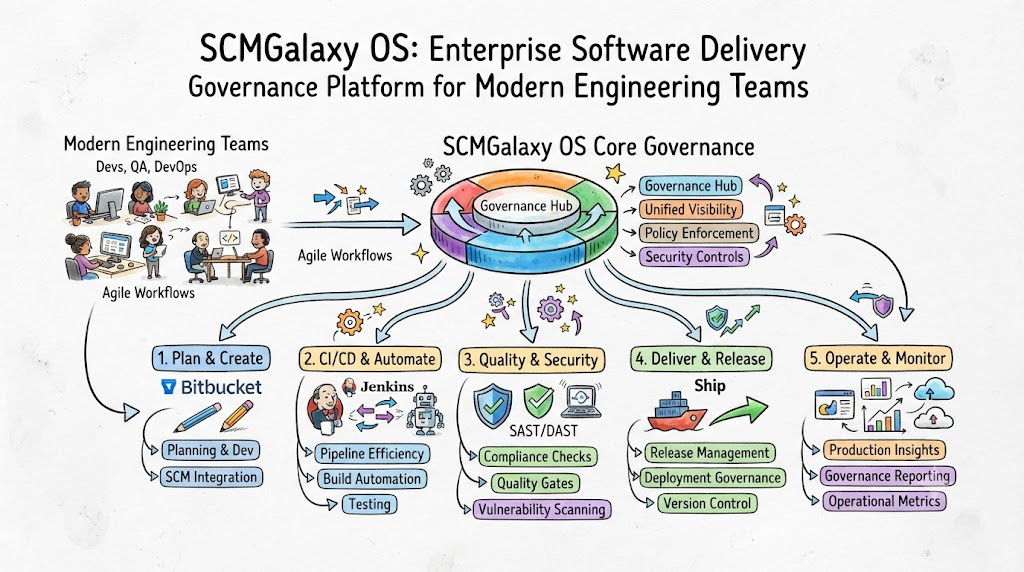
This is where SCMGalaxy OS provides a different perspective. Rather than replacing existing DevOps tools, SCMGalaxy OS acts as a governance platform that helps organizations assess, measure, and improve their complete software delivery lifecycle. It enables engineering leaders to identify maturity gaps, understand operational risks, prioritize improvements, and create structured transformation roadmaps that support long-term engineering excellence.
What SCMGalaxy OS Actually Means in a Software Delivery Context
SCMGalaxy OS is more than another DevOps dashboard or reporting solution. It functions as an enterprise software delivery governance platform designed to evaluate how effectively software moves from planning to production. Instead of focusing on isolated tools, it examines the overall maturity of engineering processes, governance standards, security practices, operational reliability, developer productivity, and organizational consistency.
The platform creates a standardized assessment framework that helps organizations understand where their delivery processes are performing well and where improvement is needed. By evaluating engineering practices across multiple governance domains, SCMGalaxy OS helps leaders move beyond assumptions and make decisions using measurable maturity scores, actionable recommendations, and structured improvement plans that support continuous software delivery excellence.
Why Modern Software Delivery Needs an Operating System Approach
Engineering organizations often rely on dozens of specialized platforms including Git repositories, CI/CD systems, infrastructure automation tools, security scanners, monitoring platforms, project management software, and cloud services. While each solution solves a specific problem, they rarely provide a complete picture of delivery maturity or governance.
An operating system approach brings these disconnected practices together under a common governance framework. Rather than replacing existing investments, SCMGalaxy OS evaluates how effectively these tools and processes work together. This holistic perspective enables engineering leaders to identify operational bottlenecks, reduce governance gaps, improve collaboration, strengthen compliance, and create consistent engineering standards across teams without disrupting existing development workflows.
Core Problems SCMGalaxy OS Is Built to Solve
Many organizations experience similar delivery challenges regardless of their industry or technology stack. Teams may have mature CI/CD pipelines but inconsistent security reviews, strong automation but weak release governance, or excellent monitoring with poor incident management practices. These isolated improvements often fail to produce predictable delivery outcomes because governance remains fragmented.
SCMGalaxy OS addresses these challenges by providing structured maturity assessments across the complete software delivery lifecycle. The platform identifies governance weaknesses, highlights process inconsistencies, measures organizational maturity, prioritizes transformation initiatives, and recommends practical improvement actions. Instead of relying on subjective opinions, engineering leaders receive measurable insights that support informed decision-making and continuous operational improvement across multiple delivery domains.
Key Capabilities That Make SCMGalaxy OS Useful
SCMGalaxy OS combines assessment, governance, analytics, and improvement planning into a unified platform that supports engineering transformation. Organizations gain visibility into their software delivery maturity while receiving actionable recommendations instead of generic reports.
Key capabilities include:
- Comprehensive software delivery maturity assessments
- Governance scoring across multiple engineering domains
- Risk identification and prioritization
- Executive dashboards and maturity reporting
- Gap analysis with actionable recommendations
- Transformation roadmap generation
- Department-wise benchmarking
- Team-level maturity tracking
- Continuous improvement planning
- Enterprise governance visibility
These capabilities help engineering organizations transform governance from reactive auditing into proactive operational improvement.
How SCMGalaxy OS Can Improve Source Code Management Governance
Source code is the foundation of modern software delivery, yet many organizations lack standardized governance around repository management, branching strategies, code reviews, merge policies, and repository security. These inconsistencies often create quality issues, security risks, and collaboration challenges.
SCMGalaxy OS evaluates source code management maturity by assessing governance practices rather than simply checking whether repositories exist. The platform reviews development workflows, branch protection policies, code review standards, repository organization, access controls, documentation quality, and collaboration practices. This assessment enables engineering teams to establish consistent development standards that improve software quality while supporting scalable engineering operations.
How SCMGalaxy OS Supports CI/CD Governance and Delivery Excellence
Continuous Integration and Continuous Delivery have become standard practices, but implementation quality varies significantly between organizations. Some pipelines emphasize automation, while others lack quality gates, security validation, rollback planning, or deployment governance.
SCMGalaxy OS evaluates the maturity of CI/CD implementations by examining automation coverage, testing integration, deployment consistency, pipeline reliability, approval workflows, release governance, and deployment risk management. Engineering leaders gain a comprehensive understanding of delivery maturity while identifying opportunities to increase automation, reduce deployment failures, improve release confidence, and standardize software delivery practices across multiple development teams.
Strengthening Release Management Through Structured Governance
Successful software delivery requires more than automated deployments. Release management involves planning, approvals, risk assessments, change coordination, stakeholder communication, rollback preparation, and post-release validation. Weak governance in these areas can create operational disruptions even when automation is highly advanced.
SCMGalaxy OS assesses release management maturity by evaluating governance practices throughout the release lifecycle. The platform identifies process inconsistencies, approval gaps, documentation weaknesses, communication challenges, and operational risks. Organizations can then establish standardized release governance that supports predictable deployments, reduces production incidents, and improves collaboration among engineering, operations, and business stakeholders.
Better Engineering Collaboration Through Shared Governance Standards
Large engineering organizations frequently struggle with inconsistent practices across development teams. Different groups may use different workflows, review processes, deployment standards, documentation approaches, or security practices, making enterprise-wide governance difficult to achieve.
SCMGalaxy OS establishes a shared governance framework that promotes consistency without eliminating team autonomy. Standardized maturity assessments allow engineering leaders to compare teams objectively, identify best practices, encourage knowledge sharing, and prioritize organization-wide improvements. This creates greater alignment across development, platform engineering, security, operations, and leadership while supporting scalable engineering growth.
Observability and Operational Reliability Become Easier
Monitoring systems generate vast amounts of operational data, but visibility alone does not guarantee reliability. Organizations also need governance around alerting, incident response, root cause analysis, service ownership, performance monitoring, and operational accountability.
SCMGalaxy OS evaluates observability maturity from a governance perspective. The platform reviews monitoring strategies, incident management practices, alert quality, service-level objectives, operational documentation, and reliability processes. These assessments help organizations improve operational resilience while ensuring that monitoring investments translate into measurable improvements in service reliability and customer experience.
Targeted Value Across Engineering Personas
Different stakeholders benefit from SCMGalaxy OS in different ways because governance responsibilities vary throughout the organization.
| Persona | Primary Value |
|---|---|
| CTOs | Strategic governance visibility and maturity benchmarking |
| Engineering Directors | Transformation planning and engineering consistency |
| DevOps Leaders | CI/CD maturity evaluation and improvement guidance |
| Platform Engineers | Standardized engineering governance frameworks |
| SRE Teams | Reliability assessments and operational improvements |
| Security Teams | Governance visibility across security practices |
| Release Managers | Structured release governance evaluations |
| Consultants | Enterprise maturity assessments for client engagements |
This role-specific visibility enables every stakeholder to focus on improvements that align with their responsibilities.
Evaluating the Ten Critical Governance Domains
SCMGalaxy OS evaluates organizations across ten governance domains that collectively represent modern software delivery maturity. Rather than focusing on individual technologies, the platform measures how effectively engineering practices support secure, reliable, scalable, and well-governed software delivery.
The assessment domains include source code management, CI/CD governance, release management, DevSecOps maturity, infrastructure automation, observability and SRE practices, developer experience, AI-assisted development governance, platform engineering capabilities, and overall software delivery governance. Evaluating these domains together provides a comprehensive understanding of organizational maturity while helping leadership prioritize investments that deliver the greatest operational impact.
Why SCMGalaxy OS Matters for Decision-Making, Not Just Monitoring
Engineering organizations collect extensive operational metrics, dashboards, and monitoring data. However, raw metrics often fail to answer strategic questions about organizational maturity, governance readiness, delivery risks, or transformation priorities. Leaders require decision support rather than additional operational reports.
SCMGalaxy OS converts technical assessments into executive-level insights. Maturity scores, governance evaluations, gap analyses, benchmarking, and prioritized recommendations provide leadership with practical guidance for resource allocation, transformation planning, investment decisions, and continuous improvement initiatives. This strategic perspective enables organizations to focus on meaningful operational improvements instead of reacting only to isolated technical metrics.
Who Can Benefit Most from SCMGalaxy OS
Organizations of different sizes and industries can benefit from structured software delivery governance, particularly when engineering complexity continues to increase.
The platform is especially valuable for:
- Enterprises managing multiple engineering teams
- Organizations undergoing DevOps transformation
- Companies implementing platform engineering
- Businesses strengthening software governance
- Consulting firms performing maturity assessments
- Regulated industries requiring governance visibility
- Organizations adopting AI-assisted software development
- Engineering leaders planning long-term transformation initiatives
These organizations gain structured governance that supports sustainable engineering growth while improving delivery consistency.
SCMGalaxy OS as a Practical Platform, Not Just a Promotional Idea
Many technology platforms promise visibility, automation, or transformation without providing measurable governance outcomes. SCMGalaxy OS takes a more practical approach by focusing on structured assessments, evidence-based maturity evaluations, actionable recommendations, and continuous improvement planning.
Rather than introducing another operational dashboard, the platform helps organizations understand where they currently stand, identify realistic improvement opportunities, prioritize governance initiatives, and measure progress over time. This practical methodology allows engineering leaders to build transformation programs based on objective assessments instead of assumptions, making governance improvements more achievable and measurable throughout the software delivery lifecycle.
What to Evaluate Before Adopting SCMGalaxy OS in Your Business
Before implementing any governance platform, organizations should understand their current engineering challenges and improvement objectives. Governance solutions deliver the greatest value when aligned with organizational priorities rather than implemented solely for reporting purposes.
Important evaluation considerations include:
- Current software delivery maturity
- Existing DevOps tool ecosystem
- Governance consistency across teams
- Security and compliance requirements
- Release management maturity
- Platform engineering adoption
- Engineering transformation goals
- Executive reporting requirements
- Improvement measurement expectations
- Long-term governance strategy
Evaluating these factors helps organizations maximize the value of structured software delivery governance.
Best Practices for Getting Maximum Value from SCMGalaxy OS
Organizations achieve stronger results when governance initiatives become part of continuous engineering improvement rather than one-time assessments. Leadership commitment, standardized processes, regular evaluations, and measurable improvement plans all contribute to long-term success.
Recommended best practices include conducting periodic maturity assessments, involving cross-functional engineering stakeholders, defining measurable improvement objectives, prioritizing high-impact governance gaps, tracking maturity progression over time, aligning governance with business objectives, promoting knowledge sharing between teams, and reviewing transformation roadmaps regularly. These practices help ensure that governance remains an active component of engineering excellence rather than a periodic compliance exercise.
Frequently Asked Questions About SCMGalaxy OS
1. What is SCMGalaxy OS?
SCMGalaxy OS is an enterprise software delivery governance platform that assesses, measures, and improves software delivery maturity across engineering organizations. It evaluates governance practices, identifies maturity gaps, and provides structured recommendations for continuous improvement.
2. Does SCMGalaxy OS replace existing DevOps tools?
No. SCMGalaxy OS complements existing engineering tools rather than replacing them. It evaluates governance and maturity across the software delivery ecosystem while allowing organizations to continue using their preferred development, automation, and monitoring platforms.
3. Which engineering areas does SCMGalaxy OS evaluate?
The platform assesses multiple governance domains including source code management, CI/CD, release management, DevSecOps, observability, platform engineering, developer experience, AI governance, and overall software delivery maturity.
4. Who should use SCMGalaxy OS?
CTOs, engineering directors, DevOps leaders, platform engineers, SRE teams, security teams, consultants, release managers, and organizations pursuing engineering transformation can all benefit from structured governance assessments.
5. Why is governance maturity important?
Governance maturity helps organizations deliver software more consistently, reduce operational risks, strengthen security practices, improve engineering collaboration, optimize investments, and support long-term business growth through structured software delivery improvements.
6. Can SCMGalaxy OS support enterprise transformation initiatives?
Yes. The platform provides maturity scoring, governance evaluations, gap analysis, executive reporting, and transformation roadmaps that help organizations prioritize improvement initiatives across multiple engineering teams.
7. How often should organizations perform maturity assessments?
Regular assessments allow organizations to monitor progress, validate improvement initiatives, identify emerging governance gaps, and continuously strengthen engineering practices as technology and business requirements evolve.
8. Is SCMGalaxy OS suitable for organizations adopting AI-assisted software development?
Yes. The platform includes governance considerations for AI-assisted development alongside traditional engineering practices, helping organizations maintain consistent governance as development approaches continue evolving.
Final Thoughts
Modern software delivery is no longer defined solely by automation or tooling. Sustainable engineering success depends on governance, operational consistency, measurable maturity, and continuous improvement across the entire delivery lifecycle. Organizations that understand their current capabilities can make better decisions about where to invest, which risks to address first, and how to build more reliable engineering practices.
SCMGalaxy OS provides a structured governance framework that transforms software delivery assessments into actionable business intelligence. By evaluating multiple engineering domains through a unified maturity model, the platform helps organizations strengthen governance, improve collaboration, reduce operational risks, and create practical transformation roadmaps that support long-term engineering excellence.