Introduction
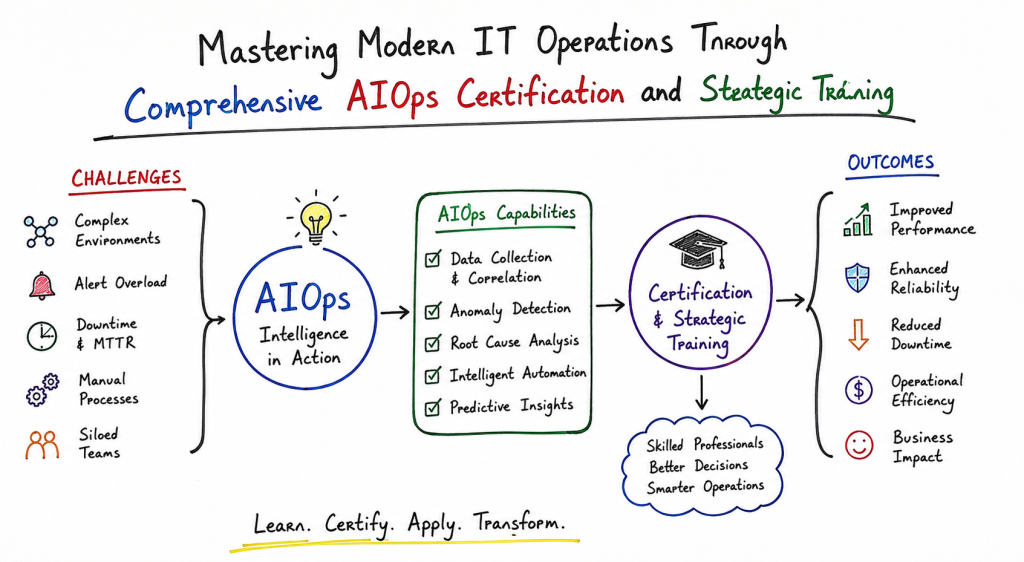
Modern IT environments have evolved into complex webs of microservices, containerized clusters, and multi-cloud architectures. For many enterprises, this shift has brought a paradox: while systems are more scalable than ever, managing them has become exponentially more difficult. A typical IT operations center today is inundated with thousands of raw alerts, logs, and metrics every hour. This “noise” obscures critical issues, leading to delayed responses and mounting downtime costs.
Imagine a global retail platform experiencing a sudden latency spike during a peak sale event. Hundreds of alerts trigger across databases, network firewalls, and application clusters. Without intelligent processing, engineers spend hours manually correlating data to find the root cause. This is where Artificial Intelligence for IT Operations (AIOps) bridges the gap between chaotic data and actionable insight. By mastering these technologies, professionals position themselves at the forefront of the next wave of IT management. At AIOpsSchool, we focus on empowering teams to transition from reactive troubleshooting to proactive, intelligent operations management.
Featured Snippet: What Is AIOps?
AIOps (Artificial Intelligence for IT Operations) is the application of machine learning, data science, and advanced analytics to IT operations data. It automatically collects, correlates, and analyzes logs, metrics, and events to identify patterns, detect anomalies, and trigger automated responses, significantly reducing noise and improving incident resolution times.
Understanding AIOps
What Is Artificial Intelligence for IT Operations?
AIOps acts as the analytical layer on top of your existing IT infrastructure. It ingest vast streams of telemetry data—logs, traces, and metrics—and uses AI models to identify what is “normal” versus what represents an actual threat or performance degradation.
Why Traditional IT Operations Are No Longer Enough
Traditional monitoring relies on static thresholds. If a server exceeds 90% CPU, an alert fires. However, in a microservices environment, 90% CPU might be perfectly normal at 2:00 PM but catastrophic at 3:00 AM. Traditional tools lack the context to distinguish between these scenarios, leading to alert fatigue.
How AI and Machine Learning Improve Operations
AIOps applies algorithms for clustering events, predicting future capacity needs, and identifying root causes in seconds rather than hours. It transforms raw data into a narrative that humans can understand.
Evolution from Monitoring to Intelligent Operations
| Traditional Operations | AIOps-Driven Operations |
| Reactive troubleshooting | Proactive incident prevention |
| Static threshold-based alerts | Dynamic, context-aware anomaly detection |
| Manual root cause analysis | Automated event correlation |
| Data silos | Unified observability dashboard |
In Simple Terms
Think of traditional monitoring as a smoke detector (it only alarms when things catch fire). AIOps is like having a thermal camera that notices the wiring heating up before the fire ever starts.
Why AIOps Skills Are Becoming Essential
The shift toward distributed systems and cloud-native infrastructure has rendered manual management obsolete. As organizations move toward SRE (Site Reliability Engineering) models, the ability to interpret AI-driven insights is now a primary differentiator for top-tier engineers.
AIOps Certification Explained
What Is an AIOps Certification?
It is a formal validation of an individual’s ability to implement, manage, and optimize AI-driven tools within an IT ecosystem. It proves you understand the intersection of data science and system reliability.
Benefits of Professional Certification
- Marketability: Signals expertise in high-demand, high-salary niches.
- Standardization: Ensures team members follow industry best practices.
- Efficiency: Reduces the learning curve for new AIOps platforms.
AIOps Training and Courses
Effective training goes beyond vendor-specific tools. It focuses on the fundamental logic of event correlation, predictive analytics, and the integration of observability frameworks like OpenTelemetry.
AIOps Engineer Certification Path
| Level | Skills | Outcome |
| Beginner | Observability fundamentals, basic Python, monitoring basics | Foundations in IT data |
| Intermediate | Event correlation, anomaly detection, API integration | Operational efficiency |
| Advanced | AI model tuning, autonomous remediation, SRE leadership | System-wide reliability |
AIOps for SRE and DevOps Engineers
Real-World Example
An SRE team at a financial firm was struggling with “alert fatigue,” where the team was woken up 15 times a night for non-critical issues. By implementing an AIOps layer, the team filtered out 90% of redundant events, grouping the remaining 10% into meaningful incidents that pointed directly to the buggy service deployment.
Why It Matters
For SREs, AIOps isn’t about replacing their jobs; it is about reclaiming their time. It allows them to focus on engineering better systems rather than chasing ghost alerts.
Enterprise AIOps Consulting and Implementation
Implementing AIOps is not a “plug-and-play” exercise. It requires:
- Maturity Assessment: Evaluating what data is currently being collected.
- Tool Selection: Choosing the right stack for the current infrastructure.
- Cultural Alignment: Training teams to trust AI-augmented decision-making.
FAQ SECTION
- What is AIOps Certification?
A formal credential confirming proficiency in using AI/ML to manage IT infrastructure and incident response. - Who should learn AIOps?
DevOps engineers, SREs, Cloud architects, and IT managers looking to optimize reliability. - What skills are required?
Strong understanding of Linux, cloud platforms, Python, and modern observability frameworks. - How does AIOps help DevOps?
It automates the “noise” of deployment monitoring, allowing faster feedback loops. - What is AI Observability?
Using AI to make distributed system data transparent and actionable. - What is OpenTelemetry?
A vendor-agnostic set of tools/APIs used to collect and export telemetry data. - How long to learn?
Depending on experience, foundations can be built in a few months of focused study. - What are AIOps Implementation Services?
Professional guidance for integrating AI models into existing IT service management (ITSM). - Is it a good career?
Yes, as organizations seek to reduce downtime and scale operations, AIOps specialists are highly sought after. - What is the future?
The move toward “self-healing” infrastructure where systems resolve their own issues before humans are alerted.
FINAL SUMMARY
The complexity of modern IT demands an intelligent approach to operations. AIOps provides the roadmap for teams to manage distributed systems at scale while reducing the cognitive load on engineers. Through structured training and professional certification, individuals can master the tools of the future, turning data into a strategic asset. To begin your journey into the world of intelligent operations, explore the resources, consulting services, and certification paths available at AIOpsSchool.