Introduction
The Certified Kubernetes Application Developer (CKAD) program is a cornerstone for any professional aiming to excel in the cloud-native ecosystem. This guide is specifically crafted for software engineers and IT professionals who want to move beyond theoretical knowledge and demonstrate their ability to design, build, and deploy applications on Kubernetes. In the modern landscape of DevOps and platform engineering, the ability to containerize applications and manage their lifecycle is no longer optional.
By pursuing this certification through DevOpsSchool, professionals can gain a structured approach to mastering the complexities of orchestration. This guide serves as a roadmap to help you navigate the certification process, understand its real-world implications, and determine how it fits into your long-term career trajectory. Whether you are aiming for a promotion or a transition into a specialized SRE role, this information will empower you to make an informed decision based on industry standards.
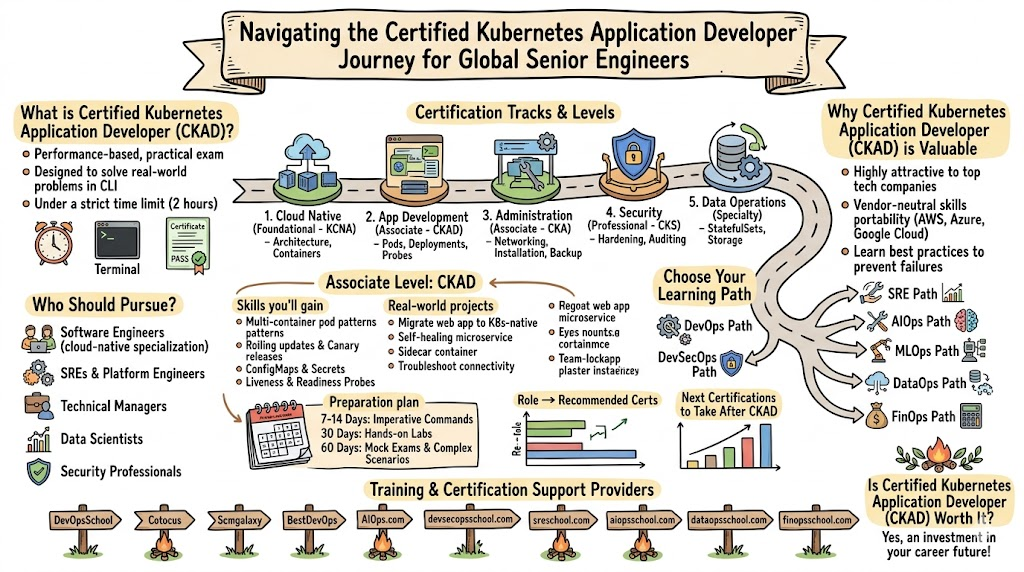
What is the Certified Kubernetes Application Developer (CKAD)?
The Certified Kubernetes Application Developer (CKAD) is a performance-based certification that verifies an individual’s ability to design, build, configure, and expose cloud-native applications for Kubernetes. Unlike traditional multiple-choice exams, this certification requires candidates to solve real-world problems in a live command-line environment. It exists to provide a standardized benchmark for the skills required to work effectively in a production-grade Kubernetes cluster.
In modern engineering workflows, the focus has shifted from manual deployments to automated, resilient, and scalable systems. The CKAD aligns perfectly with these enterprise practices by emphasizing the use of core Kubernetes primitives like Pods, Deployments, Services, and ConfigMaps. It ensures that an engineer can not only write code but also understand how that code behaves when running in a distributed system, focusing heavily on operational excellence and application reliability.
Who Should Pursue Certified Kubernetes Application Developer (CKAD)?
Software engineers and backend developers are the primary candidates for this certification, as it directly impacts how they package and deliver their software. However, Site Reliability Engineers (SREs) and Cloud Professionals also find immense value in CKAD because it bridges the gap between application development and infrastructure management. Security and Data professionals who interact with containerized workloads also benefit by understanding the deployment constraints and networking requirements of the applications they support.
The certification is relevant for beginners who want to build a strong foundation in container orchestration, as well as experienced engineers looking to validate their expertise with a globally recognized credential. In India and across the global market, there is a massive surge in demand for Kubernetes-certified talent. Engineering managers and technical leaders should also consider this path to better understand the technical challenges their teams face and to advocate for best practices in cloud-native architecture within their organizations.
Why Certified Kubernetes Application Developer (CKAD) is Valuable
The value of the CKAD lies in its massive enterprise adoption and the longevity of the Kubernetes project itself. As organizations migrate from monolithic architectures to microservices, Kubernetes has become the industry standard for orchestration. Holding a CKAD certification demonstrates that you are prepared to handle the complexities of this transition. It helps professionals stay relevant even as specific CI/CD tools or cloud providers change, because the core logic of Kubernetes remains consistent across all platforms.
From a career perspective, the return on investment is significant. It acts as a powerful signal to recruiters and technical interviewers that you possess hands-on troubleshooting skills and a deep understanding of application lifecycle management. Beyond the credential, the preparation process itself forces an engineer to master efficient command-line techniques and resource optimization. This expertise leads to faster deployment cycles, reduced downtime in production environments, and a more robust approach to building modern software.
Certified Kubernetes Application Developer (CKAD) Certification Overview
The program is delivered via the Certified Kubernetes Application Developer (CKAD) curriculum and is hosted on the DevOpsSchool platform. The assessment approach is purely practical; candidates are given a set of problems to solve on a live cluster within a two-hour time limit. This ensures that the certification is a true reflection of technical competence rather than just memorization. The program is owned by the Cloud Native Computing Foundation (CNCF) in collaboration with The Linux Foundation.
Structurally, the CKAD covers several key domains including Application Build and Deployment, Application Environment, Observability, and Networking. It is designed to be accessible yet challenging, ensuring that only those with a functional understanding of the “kubectl” command line and Kubernetes objects can pass. The certification remains valid for three years, encouraging professionals to keep their skills updated as the ecosystem evolves with new releases and features.
Certified Kubernetes Application Developer (CKAD) Certification Tracks & Levels
The Kubernetes certification ecosystem is structured to support professionals at every stage of their career. It begins with foundational certifications like the KCNA (Kubernetes and Cloud Native Associate), which focuses on conceptual understanding. The CKAD sits at the associate/professional level, focusing specifically on the application layer. For those who wish to dive deeper into cluster administration, the CKA (Certified Kubernetes Administrator) is the logical next step, followed by the CKS (Certified Kubernetes Security Specialist) for advanced security focus.
These tracks allow for significant specialization depending on your career goals. A developer might stop at CKAD and then branch into cloud-specific certifications, while an SRE might pursue the full trifecta of CKAD, CKA, and CKS. This progression aligns with career growth from a Junior Developer to a Senior Systems Engineer or a Platform Architect. By following these levels, engineers can demonstrate a comprehensive mastery of the entire cloud-native stack, from writing the YAML files to securing the underlying infrastructure.
Complete Certified Kubernetes Application Developer (CKAD) Certification Table
| Track | Level | Who it’s for | Prerequisites | Skills Covered | Recommended Order |
| Application Development | Associate | Software Developers | Basic Linux & Docker | Pods, Deployments, Services | Second |
| Cloud Native Basics | Foundational | Beginners/Students | None | K8s Architecture, Containers | First |
| Systems Administration | Professional | SREs/SysAdmins | CKAD or Experience | Cluster Install, Etcd, RBAC | Third |
| Security Operations | Advanced | Security Engineers | CKA Certification | Network Policies, Secrets | Fourth |
| Cost Management | Specialty | FinOps Analysts | Basic K8s Knowledge | Resource Limits, Quotas | Optional |
Detailed Guide for Each Certified Kubernetes Application Developer (CKAD) Certification
Certified Kubernetes Application Developer (CKAD) – CKAD Associate
What it is
The CKAD validates that an engineer can design and build applications for Kubernetes. It proves proficiency in using resource limits, environment variables, and health checks to ensure application reliability in a distributed environment.
Who should take it
This is ideal for backend developers, full-stack engineers, and junior DevOps engineers. It is suitable for those with 6–12 months of experience working with containers who want to formalize their skills.
Skills you’ll gain
- Proficiency in creating and configuring Pods and Deployments.
- Mastery of Kubernetes networking, including Services and Ingress.
- Ability to implement application observability via Liveness and Readiness probes.
- Understanding of persistent storage and volume management.
- Experience in troubleshooting application-level deployment failures.
Real-world projects you should be able to do
- Deploy a multi-tier microservices application with proper service discovery.
- Configure a rolling update strategy for a zero-downtime production release.
- Set up Blue-Green or Canary deployment patterns using Kubernetes primitives.
- Implement secure secret management and configuration injection for apps.
Preparation plan
- 7-14 Days: Focus on the CKAD curriculum, learn “kubectl” imperatives, and practice basic pod creation and editing.
- 30 Days: Complete a full hands-on course, solve lab exercises daily, and understand the relationship between different K8s objects.
- 60 Days: Conduct multiple mock exams, focus on speed and accuracy, and deep dive into complex topics like Network Policies and Sidecar patterns.
Common mistakes
- Spending too much time writing YAML from scratch instead of using imperative commands.
- Neglecting the importance of the official documentation as the only allowed resource.
- Forgetting to set the correct namespace context before running commands.
Best next certification after this
- Same-track option: Certified Kubernetes Administrator (CKA).
- Cross-track option: AWS Certified Developer Associate or Azure Developer Associate.
- Leadership option: Certified Kubernetes and Cloud Native Associate (KCNA) for a broader view.
Choose Your Learning Path
DevOps Path
The DevOps path focuses on the automation of software delivery. Here, CKAD helps you understand how to integrate Kubernetes into your CI/CD pipelines. You will learn to automate deployments and manage environment-specific configurations efficiently.
DevSecOps Path
In the DevSecOps path, the focus is on building security into the application lifecycle. CKAD provides the foundation for understanding how to define security contexts, manage secrets, and implement network policies to protect workloads from the start.
SRE Path
The Site Reliability Engineering path emphasizes availability, latency, and performance. CKAD is vital here for understanding how to set resource requests and limits, and how to use probes to ensure that the system remains self-healing.
AIOps Path
The AIOps path involves using artificial intelligence to simplify IT operations. Professionals in this path use CKAD skills to deploy AI-driven monitoring tools that can predict and remediate cluster issues before they impact the end-user.
MLOps Path
The MLOps path is dedicated to the lifecycle of machine learning models. CKAD knowledge is used to containerize training jobs and serve models as scalable microservices, ensuring that data science workloads are portable and resilient.
DataOps Path
DataOps focuses on the delivery of data and analytics. CKAD allows Data Engineers to deploy stateful applications, manage large-scale data processing jobs, and ensure that database operators are running correctly within the cluster.
FinOps Path
The FinOps path is about cloud financial management. CKAD helps you understand how application resource definitions directly impact cloud billing, allowing you to optimize Pod sizes and reduce wasted expenditure in a Kubernetes environment.
Role → Recommended Certified Kubernetes Application Developer (CKAD) Certifications
| Role | Recommended Certifications |
| DevOps Engineer | CKAD, CKA, Terraform Associate |
| SRE | CKAD, CKA, CKS, Prometheus Certified |
| Platform Engineer | CKAD, CKA, Certified ArgoCD Professional |
| Cloud Engineer | CKAD, AWS/Azure/GCP Solutions Architect |
| Security Engineer | CKAD, CKS, HashiCorp Vault Associate |
| Data Engineer | CKAD, Google Professional Data Engineer |
| FinOps Practitioner | CKAD, FinOps Certified Practitioner |
| Engineering Manager | KCNA, CKAD (for technical depth) |
Next Certifications to Take After Certified Kubernetes Application Developer (CKAD)
Same Track Progression
After completing the CKAD, the most logical step is the Certified Kubernetes Administrator (CKA). While CKAD focuses on the application, CKA teaches you how to manage the cluster itself. This includes installing the control plane, managing nodes, and handling cluster-wide networking and storage issues, making you a more versatile engineer.
Cross-Track Expansion
If you want to broaden your skills, consider a cloud-specific certification such as the AWS Certified Solutions Architect or the Google Professional Cloud Developer. These certifications help you understand how Kubernetes integrates with managed services like databases, load balancers, and identity management systems in specific cloud environments.
Leadership & Management Track
For those looking to move into management, the KCNA or even an MBA in IT Management can be beneficial. These allow you to step back from the command line and focus on the strategic implementation of cloud-native technologies, budgeting for cloud resources, and leading cross-functional engineering teams.
Training & Certification Support Providers for Certified Kubernetes Application Developer (CKAD)
- DevOpsSchool
DevOpsSchool provides a comprehensive training environment for CKAD aspirants, focusing on high-quality lab environments and real-world scenarios. Their curriculum is updated frequently to match the latest Kubernetes releases, ensuring students learn the most relevant techniques. With a strong community and expert trainers, they offer a balanced approach between theory and rigorous hands-on practice sessions. - Cotocus
Cotocus is known for its specialized consulting and training services in the cloud-native space. They provide intensive bootcamps designed to get engineers exam-ready in a short period. Their training methodology emphasizes the “learn by doing” philosophy, which is essential for passing a performance-based exam like the CKAD. - Scmgalaxy
Scmgalaxy offers a vast repository of resources, including blogs, tutorials, and community forums for Kubernetes developers. Their CKAD training modules are highly practical and focus on the common pitfalls and challenges faced in production environments. They serve as a great platform for continuous learning and community support for DevOps professionals. - BestDevOps
BestDevOps focuses on delivering high-end technical training for senior engineers and architects. Their CKAD courses are structured to provide deep technical insights into application orchestration and microservices management. They prioritize small batch sizes to ensure personalized attention and a better understanding of complex Kubernetes concepts. - devsecopsschool.com
devsecopsschool.com specializes in the intersection of security and operations. Their approach to CKAD includes a heavy emphasis on secure coding and deployment practices. This makes their training particularly valuable for engineers who want to specialize in building resilient and secure cloud-native applications from the ground up. - sreschool.com
sreschool.com focuses on the reliability aspects of Kubernetes. Their CKAD training is tailored for SREs who need to ensure that applications are not only deployed but are also scalable and maintainable. They cover advanced topics like monitoring, logging, and automated remediation within the Kubernetes framework. - aiopsschool.com
aiopsschool.com provides a unique perspective on Kubernetes by integrating AI and Machine Learning into the operations lifecycle. Their CKAD curriculum is designed for those looking to deploy intelligent workloads. They help engineers understand how to leverage Kubernetes for high-performance computing and automated decision-making. - dataopsschool.com
dataopsschool.com caters to data professionals who need to manage data pipelines on Kubernetes. Their CKAD training includes specific modules on stateful sets, persistent storage, and data security. This ensures that data engineers can confidently manage databases and analytics engines in a containerized environment. - finopsschool.com
finopsschool.com bridges the gap between engineering and finance. Their CKAD-related training focuses on resource optimization and cost-saving measures. They teach engineers how to write efficient YAML manifests that minimize resource waste and align with the organization’s cloud budget and financial goals.
Frequently Asked Questions
1. How difficult is the CKAD exam compared to other certifications?
The CKAD is considered moderately difficult because it is a hands-on, performance-based exam rather than a multiple-choice test.
2. Do I need to be a developer to take the CKAD?
While being a developer helps, anyone who understands the application lifecycle and basic Linux can successfully pass the exam.
3. How long does it take to prepare for the CKAD?
Most professionals spend between 30 to 60 days preparing, depending on their existing familiarity with Kubernetes and the command line.
4. Is there a prerequisite for the CKAD exam?
There are no formal prerequisites, but a basic understanding of Docker and Linux command-line tools is highly recommended for success.
5. What is the passing score for the CKAD?
The passing score for the CKAD exam is typically 66%, requiring a solid performance across various task categories.
6. How long is the CKAD certification valid?
The certification remains valid for three years, after which you will need to retake the exam to maintain your status.
7. Can I use the official Kubernetes documentation during the exam?
Yes, you are allowed to access the official Kubernetes documentation site during the exam, which is a vital resource.
8. What is the format of the CKAD exam?
The exam consists of 15-20 performance-based tasks that must be solved in a terminal within a two-hour window.
9. Is the CKAD better than the CKA?
Neither is “better”; CKAD is for application developers, while CKA is for cluster administrators and infrastructure-focused engineers.
10. What is the cost of the CKAD exam?
The exam cost is generally around $395 USD, though discounts are often available through various training partners and events.
11. Can I retake the exam if I fail?
Yes, the purchase of an exam voucher from the Linux Foundation typically includes one free retake if you don’t pass.
12. Does the CKAD help in getting a higher salary?
Yes, many industry surveys indicate that Kubernetes-certified professionals command higher salaries due to the high demand for these specialized skills.
FAQs on Certified Kubernetes Application Developer (CKAD)
1. What specific Kubernetes version is used in the CKAD exam?
The exam usually tracks within one or two versions of the current stable release of Kubernetes, so ensure your labs are up to date.
2. How important is speed in the CKAD exam?
Speed is critical; mastering imperative commands like “kubectl run” and “kubectl expose” is essential to finishing all tasks within the two-hour limit.
3. Do I need to know how to set up a cluster for the CKAD?
No, the CKAD focuses on interacting with an existing cluster; cluster setup and maintenance are topics covered in the CKA exam.
4. Which programming languages should I know for CKAD?
You don’t need to write code in a specific language; you just need to understand how to containerize and deploy any application.
5. What are the most heavily weighted topics in the CKAD?
Application Deployment and Application Environment (ConfigMaps, Secrets, Resources) usually carry the most weight in the current exam curriculum.
6. Is the CKAD exam proctored?
Yes, the exam is remotely proctored via webcam and screen sharing to ensure the integrity of the performance-based testing process.
7. Can I use my own IDE during the CKAD exam?
No, you must use the provided terminal and a basic text editor like Vim or Nano available within the exam environment.
8. Are there any specific Linux distributions used in the exam?
The exam environments are typically based on Ubuntu, so familiarity with basic Debian-based Linux commands is very helpful for candidates.
Final Thoughts: Is Certified Kubernetes Application Developer (CKAD) Worth It?
If you are working in a modern software environment, the CKAD is one of the most practical investments you can make in your career. It moves beyond the hype of “cloud-native” and forces you to develop the muscle memory required to manage applications in a distributed system. The industry is moving away from purely manual operations, and having a certification that proves you can thrive in a performance-based environment sets you apart from those who only have theoretical knowledge. This certification is not just a badge; it is a rigorous training process that improves your daily workflow. You will find yourself more confident in troubleshooting production issues and more capable of designing resilient systems. For any engineer or manager looking to stay ahead in the DevOps space, the CKAD provides a clear, objective measure of competence that is respected by hiring managers and peers alike. It is, without a doubt, a valuable addition to your professional toolkit.