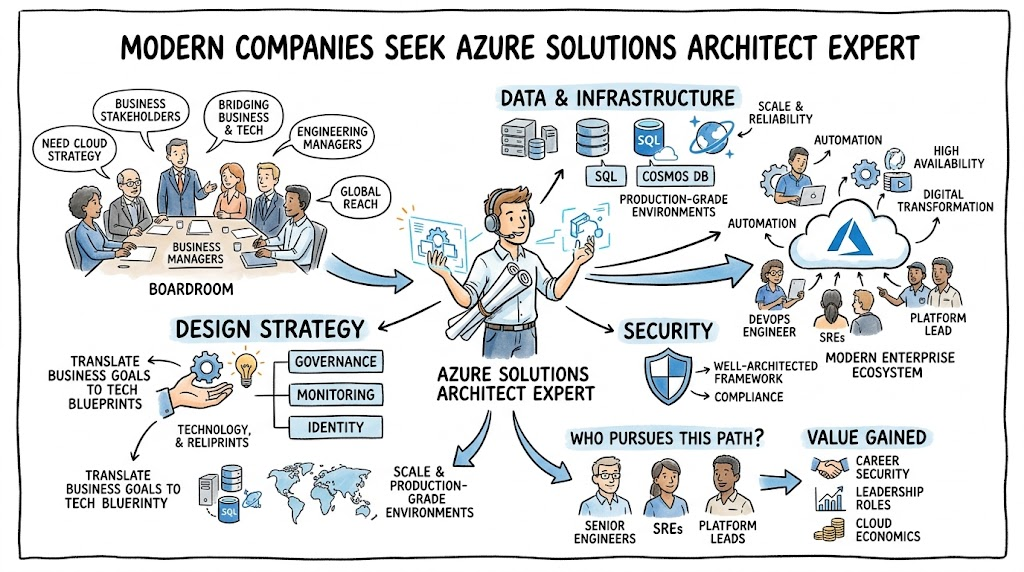
Introduction
The Azure Solutions Architect Expert certification is a premier credential for professionals who design cloud and hybrid solutions running on Microsoft Azure. This guide is designed for cloud engineers, developers, and technology leaders who want to master the art of translating business requirements into scalable, secure, and reliable cloud designs. As the industry shifts toward cloud-native and platform engineering, the ability to architect complex environments becomes a critical differentiator for career growth.
By following this guide, professionals can understand the specific requirements, technical depth, and strategic value of becoming a certified architect. Whether you are navigating a transition from traditional on-premises infrastructure or looking to lead enterprise-level DevOps transformations, DevOpsSchool provides the structured learning necessary to succeed. This roadmap clarifies how to align your technical skills with the high-level decision-making required in modern enterprise environments.
What is the Azure Solutions Architect Expert?
The Azure Solutions Architect Expert represents the pinnacle of technical expertise within the Microsoft cloud ecosystem. It exists to validate that an individual can design end-to-end solutions that incorporate compute, network, storage, and security. Unlike associate-level certifications that focus on administration or development, this expert-level credential emphasizes high-level design and the integration of various Azure services to meet specific business needs.
It focuses heavily on real-world, production-ready architectures rather than just theoretical knowledge. The curriculum aligns with modern engineering workflows by incorporating aspects of automation, disaster recovery, and cost optimization. In an enterprise setting, this role is responsible for ensuring that cloud environments are not only functional but also resilient and efficient enough to support mission-critical applications.
Who Should Pursue Azure Solutions Architect Expert?
This certification is ideally suited for experienced cloud professionals, including Senior Cloud Engineers, SREs, and Solutions Architects. It is also highly beneficial for Platform Engineers who are responsible for building the internal foundations that developers use. For those in security or data roles, it provides the necessary context to ensure that specialized workloads are integrated safely into the broader cloud ecosystem.
While it is an expert-level certification, beginners can use it as a long-term goal to guide their learning journey. Engineering managers and technical leaders also benefit from this path, as it provides the technical vocabulary and strategic understanding needed to oversee large-scale cloud migrations. In both the Indian market and the global landscape, professionals with this credential are in high demand to lead digital transformation initiatives for major enterprises.
Why Azure Solutions Architect Expert is Valuable
The demand for Azure expertise continues to grow as enterprises increasingly adopt hybrid and multi-cloud strategies. Holding the Azure Solutions Architect Expert certification ensures longevity in your career because it focuses on architectural principles that remain relevant even as specific tools and services evolve. It teaches you how to think like a designer, prioritizing security, scalability, and cost-effectiveness across the entire lifecycle of a project.
Enterprise adoption of Azure is at an all-time high, especially among organizations already integrated into the Microsoft ecosystem. This certification provides a significant return on time and career investment by positioning you for high-impact roles. By mastering these complex design patterns, you become an indispensable asset to organizations that require sophisticated cloud solutions to maintain their competitive edge in an increasingly digital economy.
Azure Solutions Architect Expert Certification Overview
The program is delivered via the Azure Solutions Architect Expert course and is hosted on DevOpsSchool. This certification is designed to test a candidate’s ability to design infrastructure, data storage, and business continuity strategies. The assessment approach is rigorous, combining scenario-based questions with practical design challenges to ensure that certified individuals can handle real-world complexities.
Ownership of the certification remains with Microsoft, but the training and preparation are facilitated through structured programs that break down the massive syllabus into digestible modules. The structure is built around core pillars of the Azure Well-Architected Framework, including reliability, security, cost optimization, operational excellence, and performance efficiency. Professionals are evaluated on their ability to make informed trade-offs between these pillars when designing solutions.
Azure Solutions Architect Expert Certification Tracks & Levels
The Azure certification path typically begins with foundation levels such as the Fundamentals (AZ-900), which introduces basic cloud concepts. From there, candidates move to the Associate level, specifically the Azure Administrator Associate (AZ-104), which serves as a vital prerequisite. The Expert level is the final stage of this specific track, requiring a deep understanding of advanced design principles across various domains.
Specialization tracks often intersect with this certification, as an architect must understand DevOps, SRE, and FinOps to build holistic solutions. As you progress from Foundation to Expert, the focus shifts from “how to click buttons” to “why a specific service is chosen.” This progression aligns perfectly with a career path leading from a junior engineer to a Lead Architect or Principal Consultant role.
Complete Azure Solutions Architect Expert Certification Table
| Track | Level | Who it’s for | Prerequisites | Skills Covered | Recommended Order |
| Core Architecture | Expert | Senior Engineers & Architects | AZ-104 Administrator | Infrastructure, Design, Data, Security | Final Step |
| Administration | Associate | Cloud Administrators | AZ-900 Fundamentals | Management, Compute, Governance | Second Step |
| Fundamentals | Foundation | Beginners & Managers | None | Basic Cloud Concepts, Pricing | First Step |
| Security | Specialty | Security Professionals | AZ-104 or AZ-305 | Identity, Threat Protection, Compliance | Concurrent |
| Data | Specialty | Data Architects | AZ-104 | SQL, NoSQL, Data Integration | Concurrent |
Detailed Guide for Each Azure Solutions Architect Expert Certification
Azure Solutions Architect Expert – AZ-104 (Prerequisite)
What it is
This certification validates the candidate’s ability to implement, manage, and monitor an organization’s Microsoft Azure environment. It focuses on the day-to-day administrative tasks required to keep a cloud infrastructure running smoothly and securely.
Who should take it
It is designed for Cloud Administrators and Engineers who have at least six months of hands-on experience in Azure. It is a mandatory step for those who eventually want to reach the Expert architect level.
Skills you’ll gain
- Managing Azure identities and governance.
- Implementing and managing storage solutions.
- Deploying and managing Azure compute resources.
- Configuring and managing virtual networking.
- Monitoring and backing up Azure resources.
Real-world projects you should be able to do
- Setting up a secure, multi-tenant virtual network with peering.
- Automating the deployment of virtual machines using ARM templates.
- Configuring Azure Load Balancer and Traffic Manager for high availability.
Preparation plan
- 7-14 Days: Focus on reviewing the official exam objectives and setting up a free Azure trial account.
- 30 Days: Complete hands-on labs for networking and compute; take at least two practice exams.
- 60 Days: Deep dive into identity (Azure AD) and governance; refine troubleshooting skills through case studies.
Common mistakes
- Ignoring the networking section, which is often the most difficult part of the exam.
- Not spending enough time on Azure PowerShell or CLI commands.
Best next certification after this
- Same-track option: Azure Solutions Architect Expert (AZ-305)
- Cross-track option: Azure Security Engineer Associate
- Leadership option: Microsoft Certified: Azure Support Engineer Guide
Azure Solutions Architect Expert – AZ-305 (Core Expert)
What it is
This certification validates advanced design skills for Azure solutions. It focuses on how to design infrastructure, data, and security components that work together to solve complex business problems effectively.
Who should take it
Senior engineers, consultants, and aspiring architects who already hold the AZ-104. It is for those who want to be responsible for high-level decision-making and design documentation.
Skills you’ll gain
- Designing business continuity and disaster recovery strategies.
- Designing data storage and integration solutions.
- Designing infrastructure and compute migrations.
- Designing security and identity solutions for the enterprise.
Real-world projects you should be able to do
- Designing a global disaster recovery plan using Azure Site Recovery.
- Architecting a migration strategy for an on-premises data center to Azure.
- Creating a serverless application architecture using Azure Functions and Cosmos DB.
Preparation plan
- 7-14 Days: Review the Azure Well-Architected Framework documentation extensively.
- 30 Days: Focus on case studies; practice mapping business requirements to specific Azure service tiers.
- 60 Days: Conduct mock architectural reviews; master the trade-offs between different SQL and NoSQL storage options.
Common mistakes
- Over-focusing on administration instead of high-level design principles.
- Failing to understand the cost implications of different architectural choices.
Best next certification after this
- Same-track option: Azure DevOps Engineer Expert
- Cross-track option: Azure Data Engineer Associate
- Leadership option: Certified Cloud Security Professional (CCSP)
Choose Your Learning Path
DevOps Path
The DevOps path focuses on automating the architectural designs created by the Azure Solutions Architect Expert. It involves mastering Azure Pipelines, GitHub Actions, and Infrastructure as Code using Bicep or Terraform. Professionals in this path bridge the gap between design and deployment, ensuring that the architect’s vision is executed through reliable CI/CD processes. This path is essential for organizations looking to increase their deployment frequency and maintain high levels of system stability.
DevSecOps Path
The DevSecOps path integrates security into every layer of the Azure architecture. While the architect designs the framework, the DevSecOps specialist ensures that security scanning, identity management, and compliance checks are automated within the development lifecycle. This path requires a deep understanding of Azure Policy, Microsoft Defender for Cloud, and Sentinel. It is a critical path for industries like finance and healthcare where data protection and regulatory compliance are non-negotiable requirements.
SRE Path
The Site Reliability Engineering (SRE) path focuses on the operational health and reliability of Azure architectures. SREs use the architect’s designs to implement advanced monitoring, alerting, and self-healing mechanisms. They focus on Service Level Objectives (SLOs) and Error Budgets to balance the need for new features with the requirement for system stability. This path is ideal for those who enjoy coding and automation to solve complex operational challenges in large-scale cloud environments.
AIOps Path
The AIOps path leverages machine learning and artificial intelligence to enhance the management and monitoring of Azure infrastructures. Professionals in this path use Azure Monitor and AI-driven insights to predict potential failures and automate incident responses. They transform traditional monitoring into a proactive system that learns from historical data. This path is becoming increasingly important as cloud environments grow too complex for manual human oversight, requiring intelligent automation to maintain high performance.
MLOps Path
The MLOps path focuses on the lifecycle management of machine learning models within the Azure ecosystem. Using Azure Machine Learning, professionals in this path ensure that models are trained, deployed, and monitored with the same rigor as traditional software. They work closely with the Azure Solutions Architect Expert to design the necessary compute and data storage foundations for large-scale AI workloads. This is a specialized path for those at the intersection of data science and cloud engineering.
DataOps Path
The DataOps path emphasizes the orchestration of data flows and the reliability of data pipelines across Azure services like Data Factory and Synapse Analytics. It applies DevOps principles to data management, ensuring that data architects and engineers can deliver high-quality data to the business quickly. This path focuses on versioning data, automating testing for data quality, and managing the infrastructure that supports massive data warehouses and real-time processing engines for enterprise analytics.
FinOps Path
The FinOps path is dedicated to the financial management and cost optimization of Azure resources. Professionals in this path work to bring accountability to cloud spending, using Azure Cost Management and Advisor to identify waste and optimize licensing. They collaborate with architects to ensure that designs are not only technically sound but also economically efficient. As cloud costs continue to rise, the ability to align cloud spending with business value has become a vital skill for modern enterprises.
Role → Recommended Azure Solutions Architect Expert Certifications
| Role | Recommended Certifications |
| DevOps Engineer | AZ-104, AZ-305, AZ-400 (DevOps Engineer Expert) |
| SRE | AZ-104, AZ-305, AZ-700 (Network Engineer) |
| Platform Engineer | AZ-104, AZ-305, HashiCorp Terraform |
| Cloud Engineer | AZ-900, AZ-104, AZ-305 |
| Security Engineer | AZ-104, AZ-500 (Security Engineer Associate) |
| Data Engineer | AZ-104, DP-203 (Data Engineer Associate) |
| FinOps Practitioner | AZ-900, AZ-104, FinOps Certified Practitioner |
| Engineering Manager | AZ-900, AZ-305 (Overview) |
Next Certifications to Take After Azure Solutions Architect Expert
Same Track Progression
Once you have achieved the Azure Solutions Architect Expert status, the most logical progression is to specialize deeply in automation. The Azure DevOps Engineer Expert (AZ-400) is the natural sibling to the architect role. While the architect designs the “what” and “why,” the DevOps engineer masters the “how” through automated pipelines and governance. This combination makes you a complete powerhouse in the Microsoft cloud ecosystem, capable of both high-level design and low-level execution.
Cross-Track Expansion
Broadening your skills into other domains is a smart move for an architect. Consider the Azure Security Engineer (AZ-500) or Azure Data Engineer (DP-203) to add specialized depth to your generalist architectural knowledge. Many architects also look toward multi-cloud expertise by pursuing the AWS Solutions Architect Professional or Google Professional Cloud Architect certifications. Understanding how different providers solve the same architectural problems will make you a more versatile and unbiased consultant for your organization.
Leadership & Management Track
If you wish to transition into technical leadership, certifications like the Certified Information Systems Security Professional (CISSP) or the PMP can be beneficial. These help you move from being a technical architect to a Chief Technology Officer (CTO) or VP of Engineering. Additionally, focusing on soft skills and business strategy certifications will help you better communicate the value of cloud investments to C-suite executives, which is a key responsibility for high-level technical leaders.
Training & Certification Support Providers for Azure Solutions Architect Expert
- DevOpsSchool: As a primary provider of cloud and DevOps training, this organization offers comprehensive bootcamps and self-paced courses for Azure aspirants. They focus on real-world scenarios and hands-on labs that go beyond the exam syllabus, ensuring that students are ready for the actual demands of an architect role. Their instructors are industry veterans who bring years of practical experience into the virtual classroom environment, providing students with unique insights that cannot be found in standard textbooks or official documentation.
- Cotocus: This provider specializes in deep-dive technical training for enterprise teams looking to upskill quickly. Their curriculum for Azure certifications is designed to be intensive and practical, focusing on the architectural trade-offs that senior engineers must make. They offer a variety of delivery formats, including corporate workshops and individual coaching, making them a flexible choice for professionals with busy schedules. Their emphasis on production-grade environments helps bridge the gap between learning a concept and applying it to a live system.
- Scmgalaxy: Focused heavily on the community aspect of learning, this provider offers a wealth of resources, including blogs, forums, and video tutorials. They are particularly strong in the areas of configuration management and infrastructure as code, which are vital components of modern Azure architecture. By participating in their ecosystem, candidates can learn from the collective experience of thousands of other engineers who have faced similar architectural challenges. Their resource library is an excellent supplement for anyone preparing for the expert-level exams.
- BestDevOps: This platform provides targeted training for those looking to master the intersection of DevOps and cloud architecture. Their courses are structured to help professionals understand the nuances of various cloud services and how they integrate into a larger automated ecosystem. They focus on clear, concise explanations and high-quality lab environments that allow students to practice complex deployments without risk. For those who prefer a structured and streamlined learning path, this provider offers a very efficient way to achieve certification.
- devsecopsschool.com: With a strict focus on the security aspect of the development lifecycle, this provider is essential for architects who want to specialize in secure cloud designs. Their courses cover advanced topics like threat modeling, automated compliance, and identity governance within Azure. As security becomes a top priority for every enterprise, the specialized knowledge offered here provides a significant advantage. Their curriculum ensures that security is seen as a foundational element of architecture rather than an afterthought or a separate silo.
- sreschool.com: This provider focuses on the reliability and operational aspects of cloud environments. Their training is geared toward engineers who want to ensure that the architectures they design are resilient, observable, and easy to maintain. They cover essential SRE topics such as incident management, error budgets, and performance tuning specifically for Azure services. For an architect, understanding these operational principles is key to designing systems that can withstand the pressures of high-traffic, real-world production workloads and evolving user demands.
- aiopsschool.com: This institution is dedicated to the emerging field of AI-driven operations. Their training helps architects understand how to incorporate machine learning models into their infrastructure monitoring and management strategies. They focus on using data to drive operational decisions and automate routine tasks. As enterprise environments become more complex, the skills taught here allow architects to design systems that are self-healing and proactive. This is a forward-looking choice for professionals who want to stay at the cutting edge of cloud management.
- dataopsschool.com: For architects who deal heavily with data-intensive applications, this provider offers specialized training in data lifecycle management and pipeline automation. Their courses cover the integration of various Azure data services and the application of DevOps principles to data engineering. They emphasize the importance of data quality, speed, and reliability in the modern enterprise. This training is crucial for ensuring that the data architecture designed by a professional is capable of supporting the advanced analytics and business intelligence needs of the organization.
- finopsschool.com: This provider addresses the critical need for financial accountability in cloud architecture. Their training teaches professionals how to manage and optimize cloud costs without sacrificing performance or innovation. They focus on the cultural and technical shifts required to implement FinOps within an organization. For an Azure Solutions Architect Expert, the ability to design cost-effective solutions is a core competency, and the specialized knowledge provided by this school helps professionals master the complex world of cloud economics and unit cost management.
Frequently Asked Questions
1. How difficult is the Azure Solutions Architect Expert exam compared to the Associate exams?
The Expert exam is significantly more difficult because it requires you to synthesize information across multiple domains. While Associate exams test your ability to perform tasks, the Expert exam tests your ability to design systems and justify your choices based on business requirements.
2. Do I really need to take the AZ-104 before the AZ-305?
Yes, Microsoft requires the AZ-104 Azure Administrator Associate certification as a prerequisite. Even if you have design experience, you must prove you understand the underlying administration and management of the platform before you can be certified as an expert architect.
3. How much hands-on experience is recommended before attempting this certification?
It is recommended to have at least two to five years of experience in IT operations, including significant time spent working with Azure. Theoretical knowledge is rarely enough to pass the scenario-based questions that are common in the AZ-305 exam.
4. What is the return on investment for this certification?
The ROI is high, often leading to significant salary increases and access to more senior roles. It validates your expertise to both current and potential employers, making you a top candidate for leadership positions in cloud-native organizations.
5. How long does it take to prepare for the Azure Solutions Architect Expert?
For someone with prior Azure experience, a period of two to three months of focused study is typical. This allows enough time to cover the wide range of topics and practice the complex architectural scenarios found in the exam.
6. Can I jump straight to the Expert level if I have years of AWS experience?
You still must pass the AZ-104 prerequisite. While your architectural concepts will carry over, you need to learn the specific Azure implementations, naming conventions, and service-level agreements which differ significantly from AWS or Google Cloud.
7. Is the Azure Solutions Architect Expert certification still relevant with the rise of AI?
It is more relevant than ever because AI workloads require robust, scalable, and secure cloud architectures to function correctly. Architects are the ones who design the foundations that allow AI models to be deployed and scaled effectively.
8. How often do I need to renew this certification?
Microsoft certifications currently require annual renewal, which is typically a free, unproctored online assessment. This ensures that your skills stay current with the frequent updates and new services released in the Azure ecosystem.
9. What are the core pillars of the exam?
The exam focuses on designing identity, security, and compliance; designing data storage; designing business continuity; and designing infrastructure. These map directly to the Microsoft Well-Architected Framework and its five core pillars.
10. Is the exam format multiple-choice or does it include labs?
The format varies but generally includes multiple-choice questions, case studies with multiple related questions, and occasionally active labs where you must perform tasks in a live Azure environment to solve a problem.
11. Which study resources are the most effective?
A combination of official Microsoft Learn documentation, hands-on lab environments from providers like DevOpsSchool, and practice exams is the most effective way to prepare for the breadth and depth of the exam.
12. Does this certification help in getting a job in India?
Yes, India has a massive demand for Azure professionals in the IT services and consulting sectors. This credential is often listed as a requirement for senior-level roles in major global tech hubs across the country.
FAQs on Azure Solutions Architect Expert
1. What specific business problems does an Azure Solutions Architect Expert solve?
An architect solves problems related to high availability, disaster recovery, and data residency. For example, they might design a system that remains operational even if an entire Azure region goes offline. They also solve cost-efficiency problems by selecting the right service tiers and scaling strategies to ensure the business only pays for what it truly needs while maintaining performance.
2. How does this certification align with the Microsoft Well-Architected Framework?
The AZ-305 exam is essentially a test of your ability to apply the Well-Architected Framework to real-world scenarios. It focuses on the five pillars: Reliability, Security, Cost Optimization, Operational Excellence, and Performance Efficiency. Candidates must demonstrate how to balance these often-competing priorities when designing a solution, such as choosing between higher reliability and lower cost for a specific workload.
3. What is the difference between a Cloud Architect and a Cloud Administrator?
A Cloud Administrator focuses on the “how” of the platform—managing users, setting up VMs, and monitoring logs. A Cloud Architect focuses on the “what” and “why”—deciding which services should be used to build a solution that meets business goals. The architect provides the blueprint, while the administrator is responsible for building and maintaining the structure according to that blueprint.
4. How does an Azure Solutions Architect Expert handle security?
Architects design security at every layer, from network isolation and firewalls to identity management and data encryption. They use services like Azure Key Vault for secret management and Microsoft Defender for threat protection. Their goal is to create a “Defense in Depth” strategy where multiple layers of security protect the organization’s most valuable assets from both internal and external threats.
5. What role does automation play in the architect’s daily work?
While architects may not write every line of code, they must design for automation. This includes choosing services that support Infrastructure as Code (IaC) and ensuring that the architecture is compatible with CI/CD pipelines. They design the environment so that it can be deployed, scaled, and updated with minimal manual intervention, which reduces the risk of human error and increases deployment speed.
6. How do architects manage data in complex Azure environments?
Architects must choose between relational databases like Azure SQL and NoSQL options like Cosmos DB based on the application’s data structure and scaling needs. They design data integration strategies using tools like Azure Data Factory to move data between systems. They also ensure that data is stored securely and is compliant with local regulations, such as GDPR or HIPAA, depending on the industry.
7. Why is the case study section of the exam so important?
Case studies simulate real-world consulting engagements. You are given a set of business requirements, technical constraints, and existing infrastructure details. You must then answer questions that test your ability to provide the best architectural solution. This section is vital because it proves you can move beyond memorizing facts and actually apply your knowledge to solve complex, multifaceted problems.
8. What is the best way to stay updated after getting certified?
The cloud changes rapidly, so staying updated is a continuous process. Following the Azure updates blog, participating in community forums like Scmgalaxy, and attending technical conferences are great ways to keep your knowledge current. The annual renewal process also helps ensure you are aware of the latest services and best practices introduced by Microsoft each year.
Final Thoughts: Is Azure Solutions Architect Expert Worth It?
The Azure Solutions Architect Expert is a challenging but highly rewarding credential that marks you as a leader in the cloud industry. It is not just about passing a test; it is about developing a mindset that prioritizes long-term stability, security, and efficiency over quick, temporary fixes. In a professional landscape where technology changes daily, the architectural principles you learn through this certification provide a solid foundation that will serve you throughout your entire career.
If you are looking for a way to differentiate yourself from the thousands of associate-level engineers, this is the path to take. It requires a significant commitment of time and effort, but the resulting expertise allows you to handle the most complex challenges that modern enterprises face. By focusing on design and strategic integration, you move away from being a technician and become a trusted advisor. This transition is the key to reaching the highest levels of technical and professional success in the cloud era. There is no hype here; just the reality that as long as businesses run on the cloud, they will need experts to design their systems.