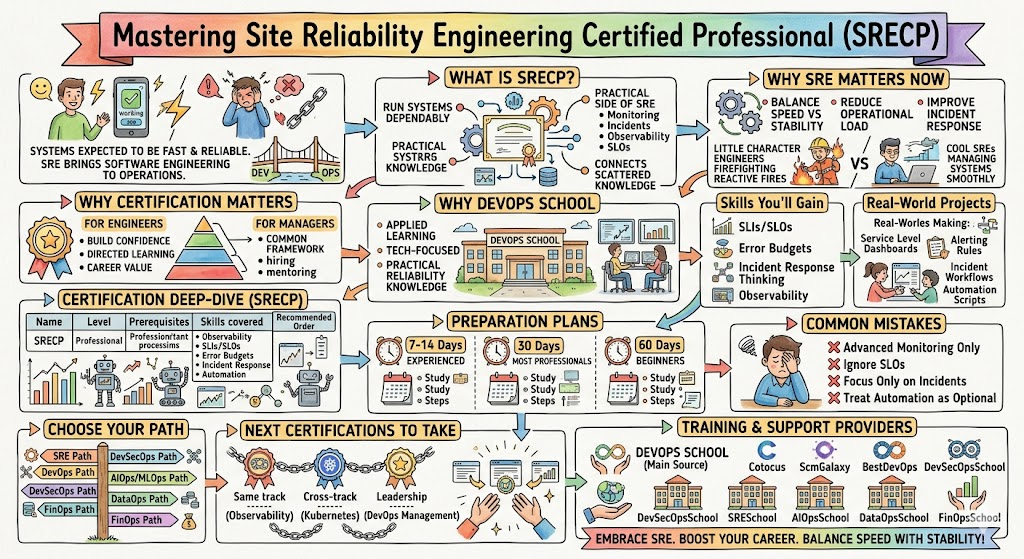
Introduction
Software systems today are expected to be available all the time. Users want fast applications, stable services, secure platforms, and smooth digital experiences. At the same time, engineering teams are releasing code faster than ever. Cloud platforms, microservices, containers, automation pipelines, and distributed systems have made software delivery more powerful, but they have also made operations more complex.
This is where Site Reliability Engineering becomes important.
Site Reliability Engineering, often called SRE, helps organizations build systems that are not only fast and scalable, but also reliable, measurable, and easier to manage. It brings software engineering thinking into operations. Instead of handling problems only after they happen, SRE teaches teams how to prevent failures, define reliability targets, automate repetitive work, and recover quickly when something goes wrong.
For working engineers and managers, this is no longer an optional skill. Reliability now affects revenue, customer trust, platform growth, team productivity, and brand value. A slow system, a failed deployment, or repeated outages can directly harm business outcomes. That is why learning SRE in a structured way has become a smart career move.
The Site Reliability Engineering Certified Professional (SRECP) certification is designed for professionals who want to understand modern reliability practices and apply them in real production environments. It gives engineers and managers a clear path to learn how high-performing teams think about uptime, incidents, observability, service goals, automation, and operational maturity.
This guide explains what SRECP is, why it matters, who should take it, how to prepare for it, what career value it offers, and which learning paths and next certifications make the most sense after it.
What is Site Reliability Engineering Certified Professional (SRECP)?
Site Reliability Engineering Certified Professional, or SRECP, is a professional certification program created for people who want to build strong skills in reliability engineering. It focuses on how to run modern systems in a dependable, scalable, and efficient way.
In simple words, this certification teaches you how to keep systems healthy in the real world.
It is not limited to theory. It covers the practical side of SRE, including service monitoring, incident handling, observability, service-level thinking, automation, infrastructure support, and platform reliability. It is meant for professionals who want to move beyond general operations and learn how reliability is engineered step by step.
SRECP is especially useful because many professionals work with parts of SRE without understanding the full model. Someone may know monitoring tools but not service-level objectives. Another person may know deployment automation but not error budgets. Someone else may be good at incident response but weak in observability design. This certification helps connect those pieces into one clear and usable framework.
That is the real value of SRECP. It turns scattered operational knowledge into a proper reliability mindset.
Why SRE Matters in Today’s Software, Cloud, and Automation Ecosystem
Modern software is no longer simple.
Applications are built with APIs, containers, cloud services, orchestration platforms, distributed databases, CI/CD pipelines, observability tools, and automated infrastructure. Teams release updates more often. User demand changes quickly. Outages spread faster across interconnected systems. One small issue can create a chain of failures.
This environment needs a better way to manage reliability.
Traditional operations approaches often focus on manual support, reactive troubleshooting, and ticket-based processes. That may help in small or stable environments, but it is not enough for fast-moving digital systems. SRE solves this problem by using engineering practices to handle operational challenges.
That means SRE teams focus on things like:
- Defining what reliability really means
- Measuring service behavior with useful indicators
- Reducing manual operational work
- Improving incident response
- Building better alerting systems
- Automating repeatable tasks
- Creating safer deployment processes
- Balancing feature delivery with service stability
This matters because every business now depends on software performance. Even internal platforms need strong availability, fast recovery, and predictable operations. Reliability is no longer just a backend concern. It is part of product quality and customer experience.
For engineers, SRE improves how systems are designed and operated.
For managers, SRE improves how teams make decisions about risk, speed, uptime, support load, and service quality.
That is why SRE has become one of the most valuable skill areas in modern engineering.
Why Certifications Matter for Engineers and Managers
Many professionals learn on the job. That is valuable. Real work teaches lessons that no book can fully replace. But experience alone can sometimes be uneven. You may learn certain tools deeply while missing the larger framework behind them.
That is where certification helps.
A good certification gives structure to learning. It helps professionals move from fragmented knowledge to organized capability. It also gives teams and employers a more visible signal that a person understands an important discipline in a serious way.
For engineers, certification can help in several ways.
First, it builds confidence. Many people work in operations, DevOps, platform engineering, or cloud support without fully knowing how their knowledge fits into a larger reliability model. A certification helps bring clarity.
Second, it improves direction. Instead of studying random tools, engineers can follow a guided path that starts from principles and moves toward implementation.
Third, it adds career value. When employers see a relevant certification backed by practical knowledge, it can strengthen a profile for roles in SRE, DevOps, cloud operations, platform engineering, and technical leadership.
For managers, certification has a different but equally important value.
Managers need a common framework to guide teams. They must understand how reliability targets are set, how incidents are handled, how automation reduces operational load, and how service quality connects to business performance. Certifications help managers build that language and use it for hiring, mentoring, planning, and team maturity.
In short, certification is useful not because a certificate alone creates expertise, but because a strong certification can organize learning, sharpen thinking, and make growth more visible and practical.
Why Choose DevOpsSchool?
DevOpsSchool is often considered because it focuses on applied learning rather than purely theoretical teaching. For a topic like Site Reliability Engineering, that matters a lot. SRE cannot be understood well through definitions alone. It needs examples, system thinking, operational use cases, and a clear understanding of how reliability works in live environments.
DevOpsSchool is also known in the training space for technology-focused programs that connect certification learning with actual engineering practices. For learners, this can make the training feel more useful because it links concepts with tools, workflows, and day-to-day engineering responsibilities.
Another reason professionals choose DevOpsSchool is that the learning path fits both engineers and managers. Some certifications are too beginner-focused. Others are too narrow. SRECP sits in a more useful place. It helps working professionals build practical reliability knowledge without losing sight of the bigger platform and operations picture.
For someone who wants to grow into reliability-focused work, platform ownership, service operations, or engineering leadership, that kind of balance is very valuable.
Certification Deep-Dive: Site Reliability Engineering Certified Professional (SRECP)
What is this certification?
SRECP is a professional certification for people who want to understand and apply Site Reliability Engineering in practical environments. It focuses on the principles, methods, and operational habits used to keep systems dependable at scale.
This certification is not just about running servers or using monitoring tools. It is about learning how reliability is designed, measured, improved, and maintained over time.
It helps professionals understand the difference between being busy in operations and being effective in reliability engineering.
Who should take this certification?
This certification is a good fit for:
- DevOps engineers who want to grow into SRE roles
- System administrators moving toward cloud-native operations
- SRE aspirants who want a structured learning path
- Platform engineers responsible for service stability
- Cloud engineers managing uptime and production environments
- Operations professionals who want stronger automation and reliability skills
- Engineering managers responsible for service quality and operational maturity
It is also useful for software engineers who interact closely with production systems and want to understand reliability from a deeper engineering perspective.
Certification Overview Table
| Certification Name | Track | Level | Who it’s for | Prerequisites | Skills covered | Recommended order | Link |
|---|---|---|---|---|---|---|---|
| Site Reliability Engineering Certified Professional (SRECP) | SRE | Professional | DevOps engineers, SRE aspirants, platform engineers, cloud engineers, managers | Basic Linux, cloud, CI/CD, monitoring, and operations exposure is helpful | Reliability engineering, observability, incident response, SLI, SLO, error budgets, automation, platform reliability | Start here for the SRE track | https://www.devopsschool.com/certification/sre-certified-professional-srecp.html |
Site Reliability Engineering Certified Professional (SRECP)
What it is
SRECP is a career-focused certification that teaches how to design and support reliable systems using modern SRE practices. It helps learners connect operational work with measurable reliability goals.
It is ideal for professionals who want to move from reactive support work to structured reliability engineering.
Who should take it
- DevOps engineers
- SRE aspirants
- Platform engineers
- Cloud engineers
- System administrators
- Operations leads
- Engineering managers
- Software engineers working closely with production systems
Skills you’ll gain
- Strong understanding of Site Reliability Engineering principles
- Ability to define and use SLIs and SLOs
- Better understanding of error budgets and release balance
- Improved incident response thinking
- Better observability and alerting awareness
- Knowledge of automation-first operations
- Understanding of reliability in cloud-native systems
- Better operational decision-making in high-scale environments
Real-world projects you should be able to do after it
- Create service-level objectives for a business application
- Design service indicators for availability, latency, and error rate
- Improve alerting quality to reduce noise
- Build a simple reliability dashboard for a service
- Create incident response workflows for production issues
- Support reliability practices in a Kubernetes-based platform
- Reduce manual tasks using automation
- Improve deployment safety through better operational controls
- Align engineering work with uptime and service goals
Preparation plan
7–14 days
This path is best for experienced professionals who already work in cloud, DevOps, platform, or operations roles. Focus on SRE principles, incident management, SLI, SLO, error budgets, observability, and high-level tool familiarity. Use this period mainly for revision, concept mapping, and practical scenario thinking.
30 days
This is the best path for most working professionals. Spend the first phase understanding SRE fundamentals. Use the next phase for hands-on learning around observability, automation, service monitoring, incident workflows, and platform reliability. Keep the final phase for revision, mock practice, and practical case analysis.
60 days
This path is ideal for beginners or career switchers. Start with Linux basics, cloud fundamentals, CI/CD, containers, and monitoring concepts. Then move into SRE practices, observability, incident handling, reliability design, and service objectives. Finish with practical mini-projects and topic revision.
Common mistakes
- Thinking SRE is only advanced monitoring
- Ignoring service-level thinking
- Memorizing terms without understanding use cases
- Studying tools without studying reliability principles
- Focusing only on incidents instead of prevention
- Not practicing real-world scenarios
- Treating automation as optional
- Missing the balance between speed and stability
Best next certification after this
The best next certification depends on your direction.
If you want to stay deeper in the reliability track, observability-focused or advanced platform certifications are a strong next step.
If you want to expand into cloud-native operations, Kubernetes-related certifications make sense.
If you want broader leadership or delivery ownership, a DevOps or architecture-focused certification can be a better next move.
Choose Your Path
DevOps Path
This path is ideal for professionals who want to master delivery pipelines, automation, infrastructure management, and release systems. SRECP adds strong production reliability knowledge to the DevOps path and helps professionals move from deployment ownership to service reliability ownership.
DevSecOps Path
This path is for professionals who focus on secure delivery and platform protection. SRECP complements this path by adding service resilience, incident thinking, and operational maturity. Security is stronger when systems are also reliable and measurable.
SRE Path
This is the direct path for professionals who want to build careers around uptime, service health, observability, incident response, and large-scale production operations. SRECP is a natural starting point here.
AIOps/MLOps Path
This path is useful for those working with machine learning platforms, intelligent automation, or AI-supported operations. SRECP adds a strong operational base by teaching how reliability should be managed even in advanced and automated environments.
DataOps Path
Data systems also need reliability. Pipelines fail, jobs break, dependencies change, and business reporting suffers when platforms are unstable. SRECP helps DataOps professionals bring better service thinking into data operations.
FinOps Path
FinOps focuses on cloud cost awareness and operational efficiency. SRECP supports this path because unreliable systems usually create waste, emergency effort, repeated failures, and poor resource usage. Reliable systems are often easier to optimize and govern.
Role to Recommended Certifications Mapping
| Role | Recommended certifications |
|---|---|
| DevOps Engineer | SRECP, DevOps-focused certifications, Kubernetes-related learning |
| SRE | SRECP first, then observability and advanced reliability certifications |
| Platform Engineer | SRECP plus Kubernetes, Terraform, and platform operations learning |
| Cloud Engineer | SRECP plus cloud architecture and cloud operations certifications |
| Security Engineer | DevSecOps certifications first, then SRECP for production resilience |
| Data Engineer | DataOps-focused learning plus SRECP for platform stability |
| FinOps Practitioner | FinOps learning plus SRECP for reliability and efficiency balance |
| Engineering Manager | SRECP plus leadership-focused DevOps, SRE, or platform strategy learning |
Next Certifications to Take
Same track
An observability-focused certification is a smart next step after SRECP. Once you understand reliability principles, the next layer is to become stronger in telemetry, monitoring design, tracing, metrics, and service visibility.
Cross-track
A Kubernetes-related certification is an excellent cross-track option. Modern reliability work often happens in containerized environments, and stronger Kubernetes knowledge helps professionals support production systems more effectively.
Leadership
A DevOps or engineering management certification is a good leadership option after SRECP. This is especially useful for professionals who want to move from technical implementation into team guidance, platform ownership, or cross-functional operational leadership.
Training and Certification Support Providers for SRECP
DevOpsSchool
DevOpsSchool is the direct and most relevant provider for this certification. It is the main source for the SRECP program and is often preferred by learners who want focused training aligned with the official certification path. It is suitable for engineers, working professionals, and teams looking for practical learning in reliability engineering.
Cotocus
Cotocus is often seen as a support-oriented technology learning and services brand. For learners, it may be useful when looking for practical help around engineering tools, cloud implementation, and technical learning support connected to modern IT roles.
ScmGalaxy
ScmGalaxy is commonly associated with technology learning around DevOps, automation, cloud, and engineering tools. It can be useful for learners who want to strengthen their fundamentals before moving deeper into specialized reliability areas.
BestDevOps
BestDevOps is often recognized in the broader DevOps and cloud learning ecosystem. It may be useful for professionals exploring structured training options across DevOps, automation, cloud, and adjacent engineering disciplines.
DevSecOpsSchool
DevSecOpsSchool is more useful for learners who want to combine reliability with security-led engineering practices. It can be a strong next-step platform for people moving from SRE into secure delivery and operational security awareness.
SRESchool
SRESchool is especially relevant for professionals who want learning focused more directly on reliability engineering, service health, monitoring strategy, and operational excellence. It fits people building dedicated SRE careers.
AIOpsSchool
AIOpsSchool can be useful for professionals interested in automation, analytics-driven operations, and AI-supported operational practices. It supports those who want to combine SRE foundations with more advanced operational intelligence.
DataOpsSchool
DataOpsSchool is helpful for learners working in data platforms and pipeline operations. It is valuable for those who want to connect platform reliability with data engineering delivery and operational consistency.
FinOpsSchool
FinOpsSchool is a useful option for professionals focused on cloud financial management, cost governance, and efficiency. For those who want to balance system reliability with resource optimization, it can complement SRE learning well.
Frequently Asked Questions
1. Is SRECP a beginner-level certification?
No, it is better described as a professional-level certification. Beginners can still pursue it, but they may need more preparation time and stronger basics in Linux, cloud, monitoring, and operations.
2. How difficult is the SRECP certification?
The difficulty is moderate to high depending on your experience. For professionals already working in DevOps, platform, or cloud roles, it becomes easier because many topics will feel familiar.
3. How much time is usually needed for preparation?
Most working professionals can prepare in around 30 days with regular study. Experienced engineers may need less time. Beginners may need closer to 60 days.
4. Are there any prerequisites?
There may not be strict formal prerequisites, but basic knowledge of Linux, cloud computing, CI/CD, system monitoring, and production support is very helpful.
5. Who should take SRECP first?
Professionals already working close to production systems should strongly consider it. That includes DevOps engineers, SRE aspirants, cloud engineers, platform engineers, and operations leads.
6. Is SRECP useful for managers too?
Yes. Managers benefit because SRE helps them understand uptime goals, incident impact, operational risk, and team reliability maturity in a more structured way.
7. Does SRECP help with job growth?
Yes. It can strengthen your profile for roles in SRE, DevOps, cloud operations, platform engineering, and technical leadership, especially when paired with real project work.
8. Is this certification only about monitoring tools?
No. Monitoring is only one part of SRE. The certification is also about service objectives, error budgets, incident response, operational design, automation, and reliability thinking.
9. Should I take SRECP before Kubernetes certification?
That depends on your role. If your focus is production reliability and service operations, SRECP can come first. If your job is heavily Kubernetes-based, both can complement each other well.
10. What is the best learning sequence after SRECP?
A good sequence is SRECP first, then observability or Kubernetes, and later a broader DevOps or leadership certification depending on your career direction.
11. Will this certification help in real projects?
Yes, especially if you apply what you learn. It can help you define service goals, improve monitoring, handle incidents better, reduce manual work, and support production systems more effectively.
12. Can software engineers take this certification?
Yes. Software engineers who work with backend systems, production platforms, cloud applications, or service performance can gain strong value from learning SRE.
FAQs on Site Reliability Engineering Certified Professional (SRECP)
1. What does SRECP stand for?
SRECP stands for Site Reliability Engineering Certified Professional.
2. What is the main purpose of SRECP?
Its main purpose is to help professionals learn how to build, run, and improve reliable systems in modern software environments.
3. Is SRECP good for DevOps engineers?
Yes. It is one of the best next steps for DevOps engineers who want to move deeper into uptime, stability, observability, and production reliability.
4. Can managers benefit from SRECP?
Yes. Managers can use SRE principles to guide better decisions around service quality, incident handling, risk, and operational priorities.
5. Does SRECP include practical learning?
Yes. The certification is most valuable when it is approached with real-world engineering thinking and practical use cases in mind.
6. Is SRECP relevant in cloud-native environments?
Very much. Cloud-native systems are complex, distributed, and fast-moving, which makes SRE practices highly relevant.
7. What should I study first before starting?
Start with Linux basics, cloud concepts, monitoring fundamentals, CI/CD, containers, and system operations basics.
8. What makes SRECP valuable in the job market?
It shows that you understand reliability beyond simple support tasks. It signals that you can think in terms of service quality, automation, resilience, and operational maturity.
Conclusion
The Site Reliability Engineering Certified Professional certification is a strong choice for professionals who want to grow beyond general operations and build real expertise in reliability engineering. It brings structure to a field that many people enter from different directions, whether from DevOps, cloud, support, platform engineering, or software development. More importantly, it teaches a way of thinking that is highly relevant in modern technology environments. Today, organizations need professionals who can balance speed with stability, automate operational effort, improve incident response, and define service quality in a measurable way. That is exactly where SRECP becomes valuable. For engineers, it builds stronger production depth. For managers, it improves operational clarity. For both, it creates a better path toward modern, high-value engineering roles.