Introduction
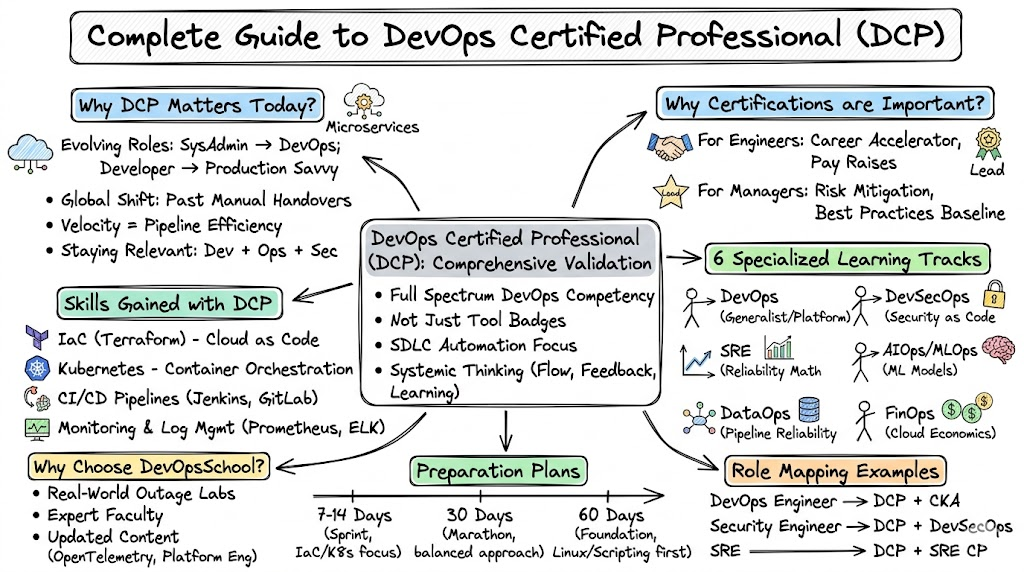
In the current landscape of Cloud-native computing and microservices, the traditional “System Administrator” role is evolving into the “DevOps Engineer,” and the “Software Developer” is now expected to understand the production environment. The gap between writing code and running code has vanished.
The global software industry has moved past the era of manual handovers and “siloed” departments. Today, the velocity of business is dictated by the efficiency of the engineering pipeline. For working engineers and managers across India and the global tech hubs, staying relevant means mastering the intersection of development, operations, and security.
The DevOps Certified Professional (DCP) is a comprehensive validation of an individual’s ability to automate the software development lifecycle (SDLC). It moves beyond basic tool knowledge to focus on systemic thinking—ensuring that quality, security, and speed are baked into every release.
What is DevOps Certified Professional (DCP)?
DevOps Certified Professional (DCP)is a professional-grade certification program that verifies an engineer’s competency in the full spectrum of DevOps. It isn’t just a “Jenkins certificate” or a “Docker badge.” Instead, it is an end-to-end validation of your ability to architect, implement, and manage automated pipelines, cloud infrastructure, and collaborative workflows.
Why it Matters in Today’s Software, Cloud, and Automation Ecosystem
In the current era of Hyper-Automation, organizations no longer have the luxury of week-long release cycles; they must move at the speed of the market to remain competitive. As modern applications scale to run on thousands of containers, the DevOps Certified Professional (DCP) program provides the essential skills required to manage this vast complexity using Kubernetes. Beyond mere scale, the “always-on” economy dictates that reliability is paramount, as even brief downtime can cost millions in lost revenue. Consequently, the DCP curriculum focuses heavily on high availability and the implementation of self-healing systems. By emphasizing cloud-agnosticism, the program ensures that while specific cloud providers may change, the core DevOps principles remain constant, giving you a robust framework that is equally effective across AWS, Azure, GCP, or private cloud environments.
Why Certifications are Important for Engineers and Managers
For Engineers, a DCP certification is a powerful career accelerator. It serves as a third-party validation of your skills, making you stand out in a sea of applicants. It often acts as the key to unlocking “Senior” or “Lead” titles and the significant pay raises that accompany them.
For Managers, certifications are a risk-mitigation tool. When you hire a DCP-certified engineer, you have a baseline guarantee that they understand industry-standard best practices. It ensures that your team is not “reinventing the wheel” but is using proven, secure, and scalable methodologies.
Why Choose DevOpsSchool?
The effectiveness of any training program is fundamentally tied to the caliber and philosophy of the practitioners driving it. DevOpsSchool has distinguished itself as an industry leader by approaching DevOps as a refined craft rather than a static curriculum. This mastery is reflected in their real-world focus, where lab environments are designed to mimic the high-stakes pressure of actual production outages and complex deployment hurdles. By learning under an expert faculty of active consultants who manage modern infrastructure daily, students gain insights that go beyond theory. Furthermore, DevOpsSchool maintains a competitive edge through its commitment to updated content, often serving as the first to integrate emerging industry shifts—such as Platform Engineering and OpenTelemetry—directly into their training modules.
About Certification: DevOps Certified Professional (DCP)
What it is
The DevOps Certified Professional (DCP) is a rigorous certification that confirms a professional’s mastery of the tools and philosophies required to unify software development and IT operations. It focuses on the “Three Ways” of DevOps: Flow, Feedback, and Continual Learning.
Who should take it
This program is specifically designed for Software Developers, Build/Release Engineers, IT Managers, and System Architects who want to move from manual operations to high-velocity automation.
Skills You’ll Gain
- Infrastructure Automation: Mastering Terraform and CloudFormation to treat your data center as code.
- Container Orchestration: Advanced management of Kubernetes clusters, including networking, storage, and security.
- Continuous Integration/Deployment: Building resilient Jenkins and GitLab CI pipelines that handle complex rollback scenarios.
- Configuration Management: Using Ansible and SaltStack to ensure thousands of servers are configured identically.
- Log Management & Monitoring: Implementing ELK (Elasticsearch, Logstash, Kibana) and Prometheus for deep system visibility.
Real-World Projects You Should Be Able to Do
- The “One-Click” Infrastructure: Automate the provisioning of a multi-region VPC with auto-scaling groups and load balancers.
- Canary Deployment Pipeline: Build a pipeline that automatically deploys a new version to 5% of users, monitors for errors, and either rolls forward or back automatically.
- Legacy to Kubernetes Migration: Re-platform a monolithic Java or .NET application into a microservices architecture running on K8s.
- Automated Security Gate: Integrate static and dynamic security analysis tools into the CI pipeline to block insecure code from reaching production.
The Master Certification Table (DevOps & Beyond)
| Track | Level | Who it’s for | Prerequisites | Skills Covered | Recommended Order |
| DevOps | Professional | Engineers, Managers | Linux, Git Basics | CI/CD, K8s, Terraform, Docker | 1 |
| DevSecOps | Advanced | Security & DevOps Pros | DCP Certification | Vault, Snyk, Sonar, Container Security | 2 |
| SRE | Advanced | Ops & Dev Engineers | DevOps Experience | SLOs, Error Budgets, Incident Response | 2 |
| AIOps/MLOps | Specialized | ML Engineers, Data Pros | Python, Basic DevOps | ML Pipelines, Model Monitoring | 3 |
| DataOps | Specialized | Data Engineers, DBAs | SQL, Cloud Fundamentals | Automated ETL, Data Quality | 3 |
| FinOps | Management | Finance & Tech Leads | Cloud Awareness | Cloud Economics, Cost Governance | 2 |
Preparation Plans for DCP Mastery
Success in the DCP exam requires a structured approach to both theory and terminal-based practice.
7–14 Days: The “Sprint” Plan (For Seasoned Engineers)
- Days 1-4: Focus on Infrastructure as Code (IaC). Deep dive into Terraform syntax and Ansible playbooks.
- Days 5-9: Containerization. Master Docker networking and Kubernetes objects (Deployments, Services, Ingress).
- Days 10-14: CI/CD & Monitoring. Build complex Jenkinsfiles and configure Prometheus alerts. Take multiple mock exams.
30 Days: The “Marathon” Plan (For Intermediate Professionals)
- Week 1: Master the Source Control & Build phase. Learn advanced Git, Maven/Gradle, and build automation.
- Week 2: Focus on Deployment. Work heavily with Docker and basic Kubernetes orchestration.
- Week 3: Automation & Configuration. Study Terraform for resource provisioning and Ansible for configuration.
- Week 4: Security & Observability. Integrate security tools and set up centralized logging. Final review of the DCP syllabus.
60 Days: The “Foundation” Plan (For Career Switchers)
- Month 1: Focus on Linux & Scripting. You cannot do DevOps without a deep comfort in the Linux CLI and Bash/Python scripting.
- Month 2: Focus on the DevOps Toolchain. Spend one week each on Git, Jenkins, Docker, and Kubernetes. The final two weeks should be spent on a “Capstone Project” integrating all these tools.
Common Mistakes to Avoid
- Tool Obsession: Don’t just learn the “buttons” of a tool. Understand the architectural pattern it solves.
- Ignoring the “Dev” in DevOps: Many Ops-heavy engineers ignore the application code. You must understand how code is compiled and packaged.
- Skipping Documentation: In the exam and real life, the ability to read and interpret official documentation is a superpower.
- Neglecting Networking: Most “DevOps issues” are actually networking issues. Master DNS, Load Balancing, and Subnetting.
Choose Your Path: 6 Specialized Learning Tracks
1. The DevOps Path
The evolution of the generalist. You become the Platform Engineer who designs the internal developer platform for the whole company.
2. The DevSecOps Path
You focus on “Security as Code.” You ensure that developers can move fast without compromising the company’s data.
3. The SRE Path
Inspired by Google’s model, you focus on the math of reliability. You manage “Error Budgets” and ensure the system stays up under massive load.
4. The AIOps/MLOps Path
The newest frontier. You help Data Scientists deploy Machine Learning models with the same rigor that developers deploy web apps.
5. The DataOps Path
You bring DevOps discipline to data lakes and warehouses, ensuring data quality and pipeline reliability.
6. The FinOps Path
A management-heavy track focused on ensuring the cloud bill doesn’t bankrupt the company. You balance performance with cost.
Role-Based Certification Mapping
| Role | Foundational | Intermediate / Core | Advanced / Tool-Specific |
| DevOps Engineer | DCP | CKA (Kubernetes) | HashiCorp Terraform |
| SRE | DCP | SRE Certified Professional | Prometheus/Grafana Certified |
| Platform Engineer | DCP | Kubernetes Security (CKS) | Pulumi / Terraform |
| Cloud Engineer | DCP | AWS/Azure Solutions Architect | — |
| Security Engineer | DCP | DevSecOps Certified | Cloud Security Specialty |
| Data Engineer | DCP | DataOps Certification | Snowflake / Databricks Certs |
| Engineering Manager | DCP | FinOps (Cloud Financial Management) | Certified Agile Leader |
Next Steps: Continuing Your Journey
- Same Track (Deepening): Focus on tool-specific mastery like the Certified Kubernetes Administrator (CKA).
- Cross-Track (Broadening): Diversify into DevSecOps to become a security-conscious architect.
- Leadership Track: Aim for FinOps or SRE Leadership to move into Director or VP roles.
Top Institutions for DCP Training
DevOpsSchool
This provider is a global leader in DevOps and DevSecOps education, offering deep-dive bootcamps and certification support. Their programs are designed by industry practitioners who focus on the “how-to” rather than just the “what.” They offer extensive hands-on labs and real-world project simulations that prepare students for the actual challenges of the job. With a strong presence in the Indian market, they provide localized support and career guidance tailored to the needs of the global tech industry.
Cotocus
A specialized consulting and training firm that focuses on high-end engineering practices and digital transformation. They provide tailored learning paths for enterprises and individuals looking to master the complexities of cloud-native security. Their approach is highly practical, emphasizing the integration of security tools within the context of large-scale infrastructure and complex software supply chains. They are known for their high-quality instructor-led sessions and personalized technical mentorship.
Scmgalaxy
One of the largest online communities for DevOps and Software Configuration Management professionals. They offer a wealth of free resources, tutorials, and certification guides that are invaluable for self-paced learners. Their structured training programs are built on years of community feedback, ensuring the content is relevant to the current market. Scmgalaxy is an excellent resource for professionals looking to stay updated on the latest open-source security tools and automation trends.
BestDevOps
This platform focuses on providing curated training experiences for the modern engineer. They offer a range of certifications and workshops that cover the entire DevOps and security spectrum. Their training is designed to be concise and high-impact, making it ideal for busy professionals who need to upskill quickly. They emphasize the practical application of tools like Jenkins, Terraform, and Vault in the context of a secure delivery pipeline.
devsecopsschool.com
The primary destination for the Certified DevSecOps Engineer program, offering direct access to the curriculum and certification exams. This site serves as the central hub for the DevSecOps community, providing the most up-to-date information on certification levels and assessment criteria. It is the go-to resource for anyone looking to formalize their skills in security automation and join a network of certified practitioners worldwide.
sreschool.com
A dedicated training platform for Site Reliability Engineering that places a heavy emphasis on the intersection of reliability and security. Their modules are designed to teach engineers how to build systems that are not only fast and scalable but also “secure by design.” They provide deep dives into observability, incident response, and the automation of security policies as part of the overall system reliability strategy.
aiopsschool.com
This provider is at the forefront of the AIOps movement, offering specialized training on the use of AI and machine learning in IT operations. Their security-focused modules teach how to use AI for anomaly detection and automated threat hunting. For engineers looking to master the next generation of security tools, this platform provides the necessary technical foundation in data-driven operations.
dataopsschool.com
Focuses on the unique security and operational challenges of the data lifecycle. Their training covers how to build secure data pipelines and ensure data integrity in automated environments. They provide practical guidance on data masking, access control, and the implementation of privacy-as-code. This is an essential resource for data engineers and privacy officers in the modern enterprise.
finopsschool.com
This platform provides training on the financial management of cloud resources, with a strong focus on how security impacts cost and efficiency. Their curriculum helps professionals identify insecure, over-provisioned resources that drive up cloud bills. They teach how to integrate financial accountability into the security automation process, ensuring that the cloud environment remains both secure and cost-effective.
FAQs: General Career & Sequence
1. Is the DCP exam hard?
It is a professional-level exam. It requires you to solve scenarios, not just memorize facts.
2. What is the average time to get certified?
Most professionals with a full-time job take 4 to 6 weeks.
3. Do I need to be a coder?
You don’t need to write complex algorithms, but you must be comfortable with scripting and YAML/JSON.
4. What is the first thing I should learn?
Git and Linux. They are the foundation of everything in DevOps.
5. How does this help my salary?
In India and the US, certified DevOps professionals consistently earn 25-40% more than generalist IT roles.
6. Can I take the exam globally?
Yes, the certification is available online and is recognized globally.
7. Is there an order for the 6 tracks?
Always start with DevOps (DCP). It provides the core context for all other tracks.
8. Does it help with remote jobs?
Absolutely. DevOps is one of the most “remote-friendly” roles in tech today.
9. Should I take the DCP before or after Cloud-specific (AWS/Azure) certs?
It is highly recommended to take the DCP first. The DCP teaches you “Cloud-Agnostic” principles. Once you understand how to build a pipeline and manage clusters independently, learning the specific buttons to push in AWS or Azure becomes significantly easier.
10. What is the real-world value of a DCP certification?
Beyond the digital badge, the value lies in “Technical Authority.” It validates that you can handle end-to-end delivery. In interviews, it moves the conversation from “Do you know this tool?” to “How did you architect this specific automation solution?”
11. What kind of salary impact can I expect after becoming a DCP?
Certified DevOps Professionals often see salary increments ranging from 30% to 55%. Because you are essentially a “Force Multiplier” who makes the entire dev team faster, you are viewed as a high-value asset rather than a cost center.
12. Does the DCP help in securing remote or international roles?
Absolutely. The “Golden Path” tools (K8s, Terraform, Git) are the universal language of modern tech. Whether a company is based in Silicon Valley, London, or Tokyo, they all use the same automation frameworks, making your DCP skills highly portable across borders.
FAQs: DevOps Certified Professional (DCP) Specifics
1. Who issues the DCP?
The certification is issued by DevOpsSchool, a globally recognized leader in DevOps education.
2. What is the passing score?
Typically, a score of 70% or higher is required to demonstrate professional competency.
3. Is there a project requirement?
Yes, most DCP paths require the successful completion of a capstone project to prove hands-on skill.
4. How long is the certificate valid?
It is recommended to re-certify or level up every 2 years to keep pace with tool updates.
5. Are there retakes available?
Yes, if you do not pass on the first attempt, there is a standard waiting period and retake policy.
6. Does it cover AWS or Azure?
It covers the principles that apply to all clouds, but labs are usually performed on major cloud providers.
7. Is the training live or recorded?
DevOpsSchool offers both, but the live-instructor-led sessions are highly recommended for the DCP track.
8. Where can I find the official syllabus?
Visit the official DCP page for the latest breakdown.
Conclusion
The DevOps Certified Professional (DCP) is not just a credential; it’s a career transformation. In a world of automated infrastructure and rapid releases, being “just a developer” or “just a sysadmin” is no longer enough. By mastering the DCP curriculum, you position yourself at the very center of the modern software economy.
Whether you are in India looking for a global career or a manager aiming to modernize your department, the path is clear. Start your journey today, master the tools, embrace the culture, and lead the future of engineering.