Introduction
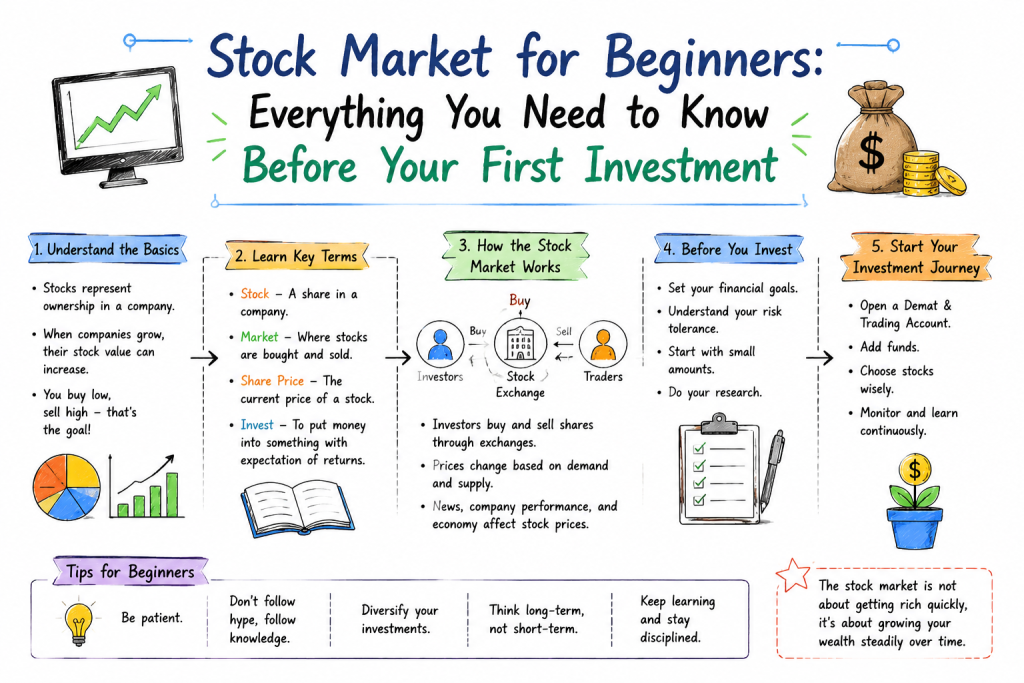
Every successful investor starts at the same place—with questions.What is the stock market? How do shares work? Is investing risky? Where should beginners start?If you’ve ever asked yourself these questions, you’re already taking the first step toward becoming a smarter investor.
The stock market isn’t just a place where people buy and sell shares. It’s a platform that allows individuals to participate in the growth of businesses, create long-term wealth, and achieve financial goals. However, investing without understanding how the market works can lead to costly mistakes.
That’s why stock market education is so important. Instead of relying on random tips, social media influencers, or market rumors, educated investors make decisions based on research, financial knowledge, and clear investment strategies.
Whether you’re completely new to investing or want to strengthen your understanding of market analysis, this guide covers everything you need to know—from stock market basics and company research to technical analysis, fundamental analysis, and IPO evaluation.
Why Stock Market Education Should Be Your First Investment
Many people believe that earning money in the stock market is about finding the “next big stock.” In reality, experienced investors know that knowledge is their biggest asset.
Learning how markets function helps you:
- Make informed investment decisions.
- Understand market risks before investing.
- Identify financially strong companies.
- Avoid common beginner mistakes.
- Build confidence during market ups and downs.
- Focus on long-term wealth creation instead of short-term speculation.
Think of stock market education as building the foundation of a house. Without a strong foundation, every investment decision becomes uncertain.
What Is the Stock Market?
The stock market is a marketplace where investors buy and sell ownership shares of publicly listed companies.
When businesses need capital to expand, they may offer shares to the public. Investors who purchase those shares become partial owners of the company and may benefit if the business grows over time.
The value of stocks changes continuously due to several factors, including:
- Company earnings
- Business performance
- Economic conditions
- Interest rates
- Industry trends
- Investor confidence
- Global events
Although prices move daily, successful investors pay more attention to business quality than short-term market noise.
Stock Market for Beginners: Understanding the Basics
If you’re just starting, it’s normal to feel overwhelmed by financial terminology and market data. The key is to learn one concept at a time.
Understand Common Market Terms
Before investing, become familiar with essential concepts such as:
- Equity shares
- Stock exchanges
- Dividends
- Market capitalization
- Bull market
- Bear market
- Portfolio
- IPO
These terms appear frequently in financial news and investment discussions.
Define Your Financial Goals
Investing without a goal often leads to emotional decisions.
Ask yourself:
- Are you investing for retirement?
- Building wealth over the next 10–20 years?
- Saving for a major purchase?
- Creating passive income?
Clear goals help shape your investment strategy.
Start Small and Learn Continuously
You don’t need a large amount of money to begin investing.
Many successful investors started with small investments while continuously improving their financial knowledge.
The focus should always be on learning before increasing your investment size.
Learn Stock Market by Understanding Different Investment Styles
Not every investor follows the same strategy. Understanding the different approaches can help you choose one that matches your goals and risk tolerance.
Long-Term Investing
Long-term investors buy quality companies and hold them for years, allowing their investments to grow through business performance and compounding.
Value Investing
Value investors look for companies trading below their intrinsic value and invest with patience.
Growth Investing
Growth investors focus on businesses expected to expand revenue and profits faster than the overall market.
Dividend Investing
Dividend investing emphasizes companies that regularly distribute a portion of their profits to shareholders, providing a source of passive income.
Knowing these approaches helps you develop an investment style that fits your financial objectives rather than copying others.
Understanding Stock Market Analysis
No investment decision should rely solely on intuition. Stock market analysis provides a structured way to evaluate investment opportunities.
There are two primary methods used by investors.
Fundamental Analysis
Fundamental analysis focuses on the financial health of a company. Investors study:
- Revenue growth
- Profit margins
- Earnings per share (EPS)
- Debt levels
- Cash flow
- Return on Equity (ROE)
- Price-to-Earnings (P/E) ratio
The objective is to determine whether a business has strong long-term potential.
Technical Analysis
Technical analysis examines price movements, chart patterns, and trading volume to understand market behavior.
Popular technical indicators include:
- Support and resistance
- Moving averages
- RSI (Relative Strength Index)
- MACD
- Candlestick patterns
While long-term investors rely heavily on fundamentals, traders often combine technical indicators to identify entry and exit opportunities.
The Importance of Stock Market Research
Research is what separates disciplined investors from speculators.
Before buying any stock, ask questions like:
- What does the company do?
- How does it generate revenue?
- Is the business profitable?
- Who are its competitors?
- Does it have long-term growth potential?
- What risks could affect future performance?
The answers provide valuable insights that help you make more confident investment decisions.
IPO Analysis: Looking Beyond the Hype
Initial Public Offerings (IPOs) often attract significant attention, but popularity doesn’t always translate into strong investment returns.
A proper IPO analysis should include:
- Understanding the company’s business model.
- Reviewing financial statements.
- Examining industry growth.
- Evaluating management experience.
- Comparing valuations with competitors.
- Identifying potential risks mentioned in the prospectus.
A careful analysis helps investors decide whether an IPO aligns with their investment strategy rather than investing based on excitement alone.
Final Thoughts
Learning the stock market is a journey, not a one-time task. Every experienced investor continues to study businesses, follow market trends, and refine their investment strategy over time.
The good news is that you don’t need to know everything before you begin. Start by building a strong understanding of market fundamentals, practice disciplined research, and invest with patience instead of emotion.
With consistent learning and informed decision-making, stock market education becomes one of the most valuable investments you can make—not just for your portfolio, but for your financial future.