Introduction
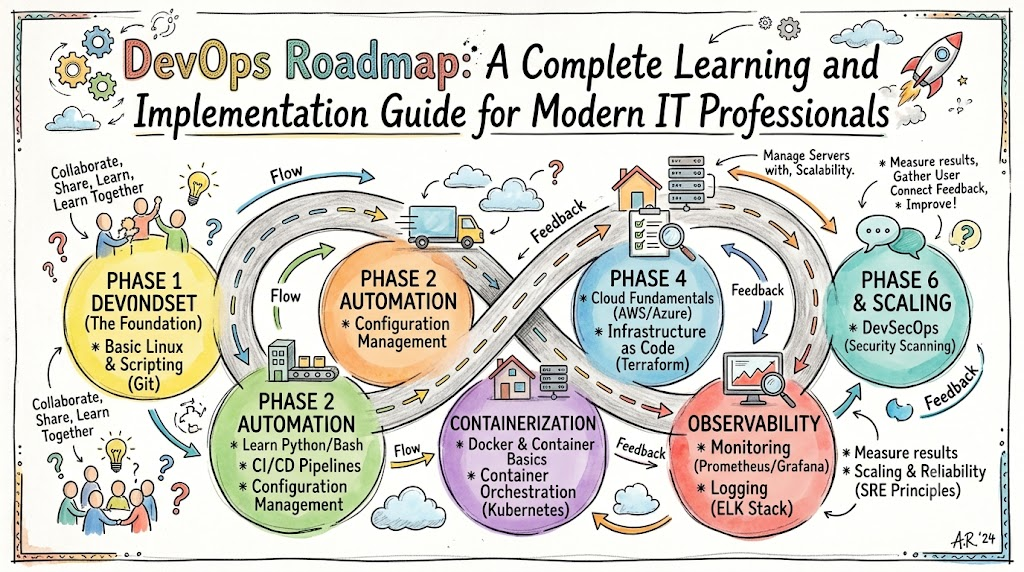
The demand for DevOps professionals continues to grow as organizations modernize software delivery, embrace cloud-native architectures, and automate infrastructure management. Yet many engineers and businesses still struggle to answer one fundamental question: Where should we begin?
Some teams invest heavily in Kubernetes before mastering continuous integration. Others migrate to the cloud without implementing Infrastructure as Code. Many organizations purchase automation tools but fail to improve deployment speed or system reliability.
A successful DevOps journey isn’t about adopting every trending technology. It’s about following a structured roadmap that builds skills, improves collaboration, automates repetitive work, and delivers measurable business outcomes.
Whether you’re a software developer, system administrator, cloud engineer, IT manager, or business leader, this guide explains the complete DevOps roadmap—from foundational skills to advanced cloud-native engineering—and shows how experienced guidance from a DevOps trainer and consultant can accelerate transformation.
Understanding the DevOps Mindset
DevOps is more than automation. It is a culture of collaboration where development, operations, security, and quality assurance teams work together throughout the software lifecycle.
Instead of handing software from one department to another, DevOps encourages shared ownership. Teams plan together, build together, test together, deploy together, and continuously improve based on feedback.
A mature DevOps culture delivers:
- Faster software releases
- Improved product quality
- Better collaboration
- Reduced operational costs
- Stronger security
- Higher customer satisfaction
- Reliable production systems
Stage 1: Build Strong Technical Foundations
Every successful DevOps engineer begins with core technical knowledge.
Linux Administration
Linux powers most cloud infrastructure. Engineers should understand:
- File systems
- Permissions
- Package management
- Process management
- Networking
- Shell scripting
- User administration
- System monitoring
Without Linux knowledge, advanced DevOps tools become difficult to manage.
Networking Fundamentals
Networking knowledge is equally important.
Learn:
- TCP/IP
- DNS
- HTTP and HTTPS
- SSH
- Firewalls
- Reverse proxies
- Load balancers
- SSL certificates
- VPNs
Many deployment failures are actually networking problems.
Version Control with Git
Git is the foundation of collaborative software development.
Important concepts include:
- Repository management
- Branching strategies
- Pull requests
- Merge conflicts
- Tags
- Releases
- Code reviews
Version control isn’t just for application code. Infrastructure definitions, Kubernetes manifests, pipeline configurations, and documentation should also be stored in Git.
Stage 2: Continuous Integration
After mastering Git, organizations should automate software builds.
Continuous Integration ensures every code change is automatically validated.
Typical CI workflow:
Developer Commit
↓
Automatic Build
↓
Static Code Analysis
↓
Unit Testing
↓
Artifact Creation
↓
Artifact Repository
↓
Deployment Ready
This process catches problems before they reach production.
Popular CI platforms include Jenkins, GitHub Actions, GitLab CI, and Azure DevOps.
Stage 3: Continuous Delivery
Continuous Delivery extends automation beyond builds.
Instead of manually deploying software, release pipelines automatically move applications through development, testing, staging, and production environments.
A modern deployment pipeline should include:
- Automated testing
- Security scanning
- Code quality checks
- Deployment approvals
- Rollback automation
- Deployment notifications
Organizations that automate releases often reduce deployment errors while increasing release frequency.
Stage 4: Infrastructure as Code
Manual server creation doesn’t scale.
Infrastructure as Code allows teams to provision infrastructure using reusable, version-controlled code.
Benefits include:
- Faster provisioning
- Environment consistency
- Disaster recovery
- Easier audits
- Better collaboration
Popular technologies:
- Terraform
- Ansible
- CloudFormation
- Pulumi
IaC enables organizations to recreate entire environments quickly and reliably.
Stage 5: Containers and Kubernetes
Containers package applications with all required dependencies, ensuring they run consistently across environments.
Kubernetes orchestrates these containers by handling:
- Scheduling
- Auto scaling
- Service discovery
- Load balancing
- Rolling updates
- High availability
- Self-healing
Organizations should adopt Kubernetes only when they have a genuine need for scalable container orchestration.
Stage 6: Cloud Engineering
Modern DevOps teams commonly work with public cloud platforms.
Important cloud skills include:
- Virtual machines
- Storage
- Networking
- IAM
- Serverless services
- Managed databases
- Kubernetes services
- Monitoring
- Cost optimization
Cloud knowledge should be combined with automation rather than relying on manual console operations.
Stage 7: DevSecOps
Security should be integrated into every phase of software delivery.
Key DevSecOps practices include:
- Dependency scanning
- Static application security testing
- Container image scanning
- Secret detection
- Infrastructure scanning
- Compliance validation
Automated security reduces risk without slowing development.
Stage 8: Observability
Monitoring answers one question:
“Is the system healthy?”
Observability answers a much more important question:
“Why is the system behaving this way?”
A complete observability strategy includes:
- Metrics
- Logs
- Distributed tracing
- Dashboards
- Alerting
- Incident timelines
These capabilities help teams detect and resolve issues before customers are affected.
Stage 9: Site Reliability Engineering
SRE focuses on keeping services reliable while allowing innovation.
Core concepts include:
- Service Level Objectives
- Error Budgets
- Incident Response
- Automation
- Capacity Planning
- Root Cause Analysis
SRE helps organizations balance new feature development with operational stability.
Stage 10: Platform Engineering
As engineering teams grow, maintaining separate pipelines and infrastructure for every team becomes inefficient.
Platform Engineering solves this challenge by providing reusable internal platforms.
These platforms typically include:
- CI/CD templates
- Kubernetes environments
- Self-service deployments
- Security policies
- Monitoring dashboards
- Developer portals
This improves developer productivity while maintaining governance.
Common Mistakes During DevOps Adoption
Many organizations repeat the same mistakes:
- Purchasing tools before defining processes
- Ignoring developer training
- Overcomplicating Kubernetes
- Skipping Infrastructure as Code
- Treating security as a final step
- Not measuring DevOps success
- Lack of executive sponsorship
Avoiding these mistakes significantly improves transformation success.
Skills Required for Modern DevOps Engineers
Today’s DevOps professionals should continuously improve in:
- Linux
- Git
- Docker
- Kubernetes
- Terraform
- Jenkins
- Cloud Platforms
- Monitoring
- Networking
- Security
- Python
- Bash
- Platform Engineering
Soft skills are equally important, including communication, collaboration, troubleshooting, and leadership.
Why Professional DevOps Training Matters
Many professionals spend months watching videos and reading documentation but struggle to apply concepts in real-world environments.
Professional training accelerates learning by providing:
- Structured curriculum
- Hands-on labs
- Enterprise use cases
- Best practices
- Mentorship
- Practical troubleshooting
- Architecture guidance
Organizations also benefit from customized corporate training aligned with their technology stack and business goals.
Choosing the Right DevOps Consultant
When selecting a DevOps consultant or trainer, evaluate:
- Enterprise implementation experience
- Cloud expertise
- Kubernetes knowledge
- CI/CD specialization
- Security understanding
- Infrastructure automation skills
- Real-world project experience
- Ability to train engineering teams
Experienced consultants help organizations avoid costly mistakes while accelerating cloud-native adoption.
Final Thoughts
The DevOps journey is continuous. Technology evolves rapidly, but the core principles remain constant: collaboration, automation, continuous improvement, and reliability.
Organizations that invest in structured learning, practical implementation, and expert guidance build resilient engineering teams capable of delivering software faster, more securely, and with greater confidence.
Whether you’re beginning your DevOps career or leading enterprise transformation, following a clear roadmap and learning from experienced practitioners can dramatically shorten the path to success.
Frequently Asked Questions
What should I learn first for DevOps?
Start with Linux, networking, Git, and scripting before moving to CI/CD, containers, cloud platforms, and Kubernetes.
Is Kubernetes mandatory for DevOps?
No. Kubernetes is valuable for container orchestration but isn’t required to begin adopting DevOps practices.
How long does it take to become a DevOps engineer?
The timeline varies depending on your background, but consistent hands-on practice and structured learning significantly speed up progress.
Why do organizations hire DevOps consultants?
Consultants help design automation strategies, implement best practices, optimize cloud infrastructure, train teams, and reduce implementation risks.
What is the biggest mistake in DevOps adoption?
Focusing on tools instead of culture, collaboration, automation, and measurable business outcomes.